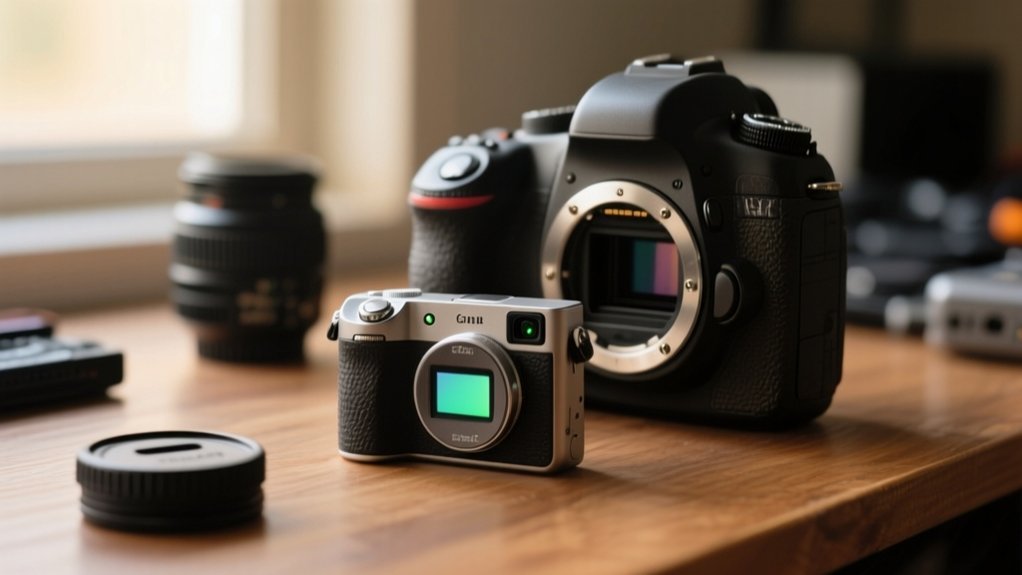
Why Are Mirrorless Cameras Better Than DSLRs?
You’ll find mirrorless cameras outperform DSLRs with their compact, lightweight design that boosts portability and reduces fatigue. Their electronic viewfinders give you real-time exposure previews and critical data for precise control, eliminating parallax errors.
Advanced hybrid autofocus covers nearly the entire sensor and excels at tracking subjects quickly and accurately. Plus, mirrorless models offer superior video capabilities with quiet operation and high-resolution recording.
Uncover how these innovations redefine imaging performance and usability.
Key Takeaways
- Mirrorless cameras are more compact and lightweight, enhancing portability and reducing user fatigue during extended shoots.
- Electronic viewfinders provide real-time exposure previews and 100% coverage for precise composition without parallax errors.
- Advanced hybrid autofocus systems offer faster, more accurate focusing with extensive coverage and reliable subject tracking.
- In-body stabilization and fewer moving parts reduce camera shake and vibration, improving image sharpness and low-light performance.
- Superior video capabilities include silent operation, high-resolution 4K/8K recording, and continuous autofocus on moving subjects.
What Makes Mirrorless Cameras Different From DSLRs
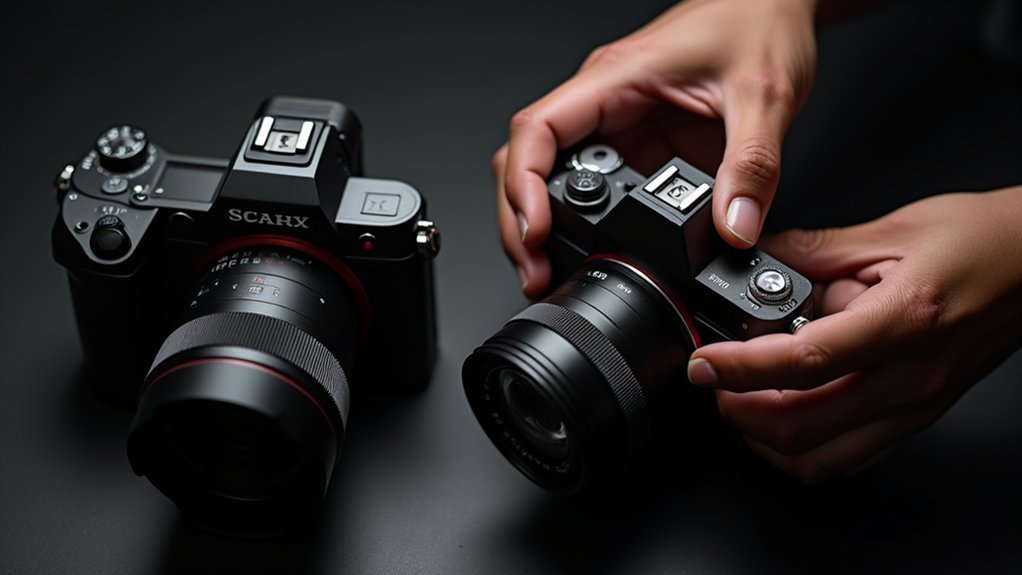
Although both mirrorless cameras and DSLRs serve the core purpose of capturing high-quality images, mirrorless models distinguish themselves through the absence of a mechanical mirror system. This enables a considerably more compact and lightweight design.
Unlike traditional DSLRs, which rely on an optical viewfinder and a bulky mirror mechanism, mirrorless cameras employ an electronic viewfinder (EVF). The EVF delivers a real-time exposure preview and critical shooting data, which improves your framing accuracy and streamlines adjustments on the fly.
Mirrorless cameras use electronic viewfinders for real-time previews, enhancing framing accuracy and quick adjustments.
Furthermore, modern mirrorless cameras boast advanced autofocus capabilities, often covering the entire sensor area. This surpasses the limited, center-focused points of many DSLRs.
With fewer moving parts, mirrorless cameras reduce camera shake and vibrations from mirror slap, ultimately enhancing image quality and operational quietness.
Smaller, Lighter Cameras for Better Usability
Beyond their advanced autofocus and electronic viewfinders, mirrorless cameras offer considerable advantages in size and weight compared to DSLRs. Their smaller, lighter construction results from eliminating the mirror mechanism, enhancing portability and reducing physical strain during extended use.
This compact design makes storage straightforward. You can fit your gear into tighter spaces and achieve easier access when shooting outdoors. Moreover, the streamlined body often integrates features like flip screens, improving usability for challenging angles without awkward positioning.
Because mirrorless cameras weigh less, you gain the flexibility to carry extra lenses and accessories without burden, expanding your creative options.
Electronic Viewfinders That Enhance Shooting
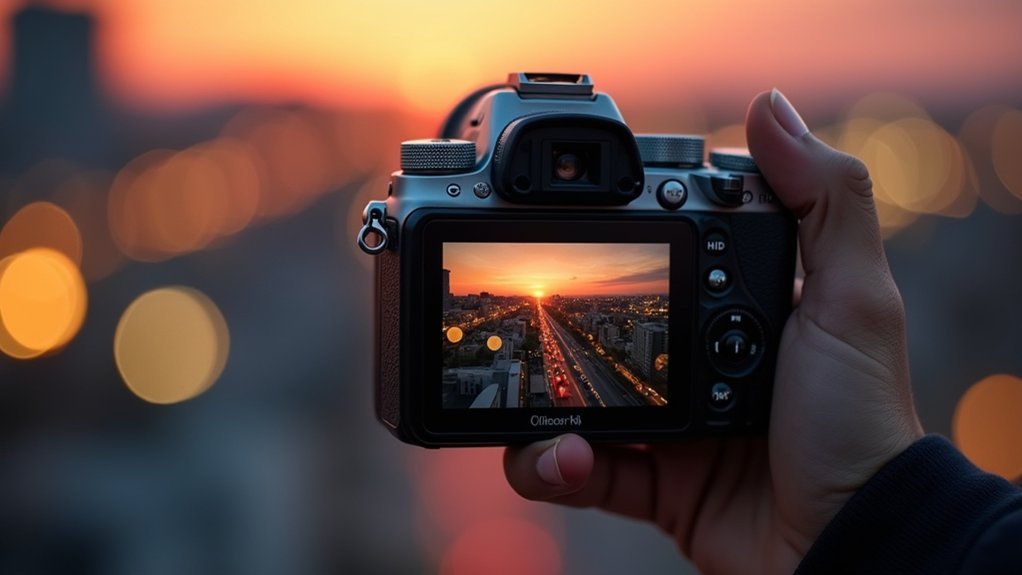
When you look through an electronic viewfinder (EVF), you get an immediate, real-time preview of your exposure settings, enabling precise adjustments before capturing the image.
Unlike the optical viewfinder (OVF) in DSLRs, the EVF improves your shooting experience by integrating critical data directly into the viewfinder.
Here’s how EVFs enhance your workflow:
- Provide 100% viewfinder coverage, eliminating parallax error and ensuring exact composition.
- Display exposure previews, histograms, and focus peaking overlays for accurate focusing and exposure control.
- Offer real-time image review within the EVF, allowing rapid adjustments without breaking your shooting rhythm.
- Feature minimal lag times, delivering a smooth and responsive view even in challenging lighting.
This advanced functionality makes the EVF an essential tool that outperforms traditional OVFs in precision and efficiency.
Faster, Smarter Autofocus in Mirrorless Cameras
Since mirrorless cameras employ hybrid autofocus systems combining phase-detection and contrast-detection, they deliver faster and more accurate focusing than traditional DSLR autofocus.
This hybrid approach enables mirrorless cameras to achieve faster autofocus performance, particularly in challenging lighting. You benefit from autofocus points covering nearly the entire sensor, enhancing your ability to track moving subjects with precision.
Advanced subject detection algorithms, including eye detection, guarantee reliable focus on faces even during rapid motion.
Eye detection technology ensures precise focus on faces, even when subjects move quickly.
Mirrorless cameras also utilize electronic shutters, eliminating mirror slap and reducing image blur during high continuous shooting speeds, often reaching 20 to 40 frames per second, far surpassing DSLR mechanical limits.
Altogether, these technologies empower you to capture sharp, well-focused images in dynamic environments where traditional DSLRs struggle.
Superior Video Features and Quick Tech Adaptation
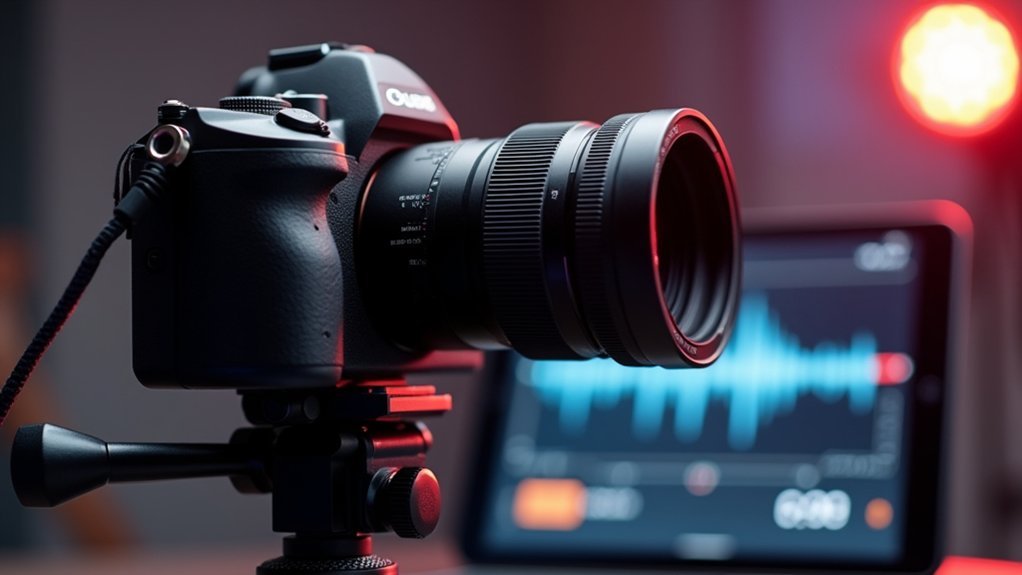
Although both camera types handle still photography well, mirrorless cameras clearly excel in video capabilities. Their quick tech adaptation drives continuous innovation, offering you superior video capabilities that DSLR models struggle to match.
Here’s why mirrorless cameras lead in videography:
- Advanced video recording options, including 4K and 8K at high frame rates, deliver cinematic quality.
- Quiet operation, enabled by the absence of a mirror mechanism, guarantees unobtrusive audio capture.
- Cutting-edge autofocus systems with real-time eye tracking and machine-learning algorithms maintain sharp focus on moving subjects.
- Improved low-light performance combined with in-body stabilization allows stable, clear footage in challenging conditions.
This rapid tech evolution makes mirrorless cameras the preferred choice for videographers demanding precision and versatility.
Frequently Asked Questions
How Do Battery Lives Compare Between Mirrorless Cameras and DSLRS?
You’ll find that mirrorless cameras generally have shorter battery lives compared to DSLRs.
Mirrorless models rely heavily on electronic viewfinders and sensors, which drain power faster, typically allowing 300 to 600 shots per charge.
In contrast, DSLRs use optical viewfinders that consume less energy, often providing 800 to 1,200 shots on a single charge.
To compensate, you should carry extra batteries when using mirrorless cameras for extended shooting.
Are Mirrorless Cameras More Expensive Than DSLRS?
Yes, mirrorless cameras tend to be more expensive than DSLRs, mainly because of their advanced technology like electronic viewfinders and improved autofocus systems.
However, as the market evolves, you’ll find many competitively priced mirrorless models.
Manufacturers’ focus on mirrorless innovation drives R&D costs up, but older DSLR prices are dropping, narrowing the gap.
Can I Use My Old DSLR Lenses on a Mirrorless Camera?
Yes, you can use your old DSLR lenses on a mirrorless camera with the right adapter.
These adapters maintain autofocus and image stabilization, preserving your lenses’ full capabilities. Brands like Canon and Nikon provide specialized adapters to guarantee seamless integration.
Keep in mind, though, autofocus speed and accuracy might slightly lag due to technological differences.
Using your DSLR lenses expands your creative options, even if it reduces the compactness mirrorless cameras are known for.
How Durable Are Mirrorless Cameras Compared to DSLRS?
You’ll find mirrorless cameras are highly durable, often matching or exceeding DSLRs.
With fewer mechanical parts, they reduce wear and risk of failure from mirror slap.
Many feature weather-sealed bodies protecting against dust and moisture, similar to robust DSLRs.
Modern materials and engineering guarantee mirrorless models withstand rigorous outdoor use.
Do Mirrorless Cameras Perform Well in Low Light Conditions?
In terms of low light, mirrorless cameras really hit the nail on the head.
You’ll benefit from larger full-frame sensors that capture more light and advanced noise reduction, letting you shoot cleaner images at high ISOs.
Their in-body image stabilization reduces shake, while electronic viewfinders give you precise real-time exposure previews.
Plus, autofocus systems use hybrid detection for sharp focus in dim conditions, making mirrorless a top choice for challenging lighting.
Conclusion
When choosing between mirrorless cameras and DSLRs, you’ll find mirrorless models pack a punch with their compact design, advanced electronic viewfinders, and lightning-fast autofocus systems. They keep you ahead of the curve, especially with superior video capabilities and quick tech adoption.
If you want to hit the ground running in photography and videography, mirrorless cameras give you the edge without weighing you down, proving that sometimes, less really is more.