How Many Cameras Does a Tesla Have?
Tesla vehicles are known for blending cutting-edge technology with everyday driving, and one of the most talked-about features is their advanced camera system. These cameras play a major role in safety, driver assistance, and the overall smart driving experience that Tesla owners rely on daily.
When people explore Tesla’s Autopilot and Full Self-Driving capabilities, curiosity naturally grows around the hardware that makes it all work. A common question that comes up is how many cameras does a Tesla have, especially for those comparing models or considering a purchase.
Cameras in a Tesla are not just add-ons; they are constantly active, monitoring surroundings, detecting objects, reading road markings, and supporting real-time decision-making. Each camera is positioned strategically to provide a comprehensive view of the vehicle’s environment from multiple angles.
Understanding the number and purpose of these cameras helps drivers better appreciate how Tesla’s technology enhances awareness, improves safety, and continues to evolve through software updates that refine how the system interprets the road.
How Many Cameras Are on a Tesla?
Tesla vehicles are equipped with a sophisticated camera system designed to support advanced safety and driver-assistance features. At the core of this setup is a network of cameras that work together to give the car a detailed, real-time understanding of its surroundings. This system is a key component of Tesla’s approach to autonomous driving.
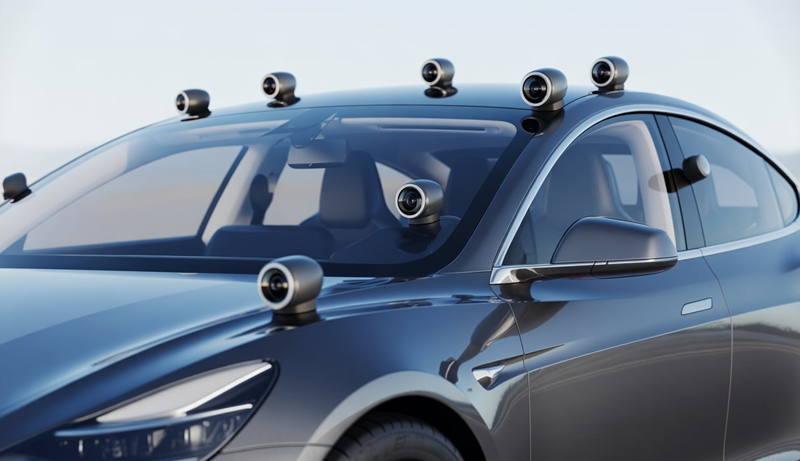
Currently, most modern Tesla models are built with eight exterior cameras. These cameras are strategically placed around the vehicle to provide nearly 360-degree visibility. They include front-facing cameras that look far ahead, side cameras that monitor adjacent lanes, and rear-facing cameras that track traffic behind the vehicle.
The front of the car typically houses three cameras with different focal lengths, allowing the vehicle to detect both nearby objects and distant road conditions. On each side, cameras help with lane changes, blind-spot monitoring, and merging in traffic. The rear camera supports reversing, parking, and awareness of approaching vehicles.
Together, these eight cameras continuously collect visual data that feeds into Tesla’s Autopilot and Full Self-Driving systems. This data helps the vehicle recognize lane markings, traffic signals, pedestrians, cyclists, and other vehicles in various driving environments.
Understanding how many cameras are on a Tesla gives insight into how the vehicle “sees” the road. It also highlights how Tesla relies on vision-based technology, combined with powerful software, to enhance safety, improve driver confidence, and move closer to fully autonomous driving.
Overview of Tesla’s Camera System
Tesla has developed a camera-based perception system that serves as the foundation for its advanced driver-assistance and autonomous driving technologies. Rather than relying heavily on traditional sensors, Tesla prioritizes visual data to help vehicles understand and react to their surroundings in real time.
The camera system is designed to provide a near-complete view around the vehicle. Multiple exterior cameras work together to monitor traffic, lane markings, road signs, pedestrians, and other potential hazards. This constant stream of visual information allows the vehicle to build an accurate picture of the driving environment.
Each camera is positioned with a specific purpose, covering short, medium, and long-range visibility. This layered approach helps the system detect objects both close to the car and far ahead on the road, improving reaction time and decision-making.
Tesla’s cameras operate continuously while driving, supporting features such as Autopilot, traffic-aware cruise control, lane keeping, and automated lane changes. The system improves over time through software updates, refining how visual data is processed and interpreted.
Overall, Tesla’s camera system reflects the company’s vision-first strategy for vehicle safety and autonomy. By combining multiple cameras with powerful onboard computing, Tesla aims to deliver a driving experience that becomes smarter, safer, and more capable with every update.
Where Are the 8 Tesla Cameras Located?
Tesla vehicles use a carefully designed camera layout to achieve wide environmental awareness and precise visual coverage. All eight exterior cameras are positioned to eliminate blind spots and support advanced driver-assistance features like Autopilot and Full Self-Driving. Each camera has a unique role, range, and viewing angle, allowing the vehicle to interpret road conditions, traffic behavior, and obstacles with high accuracy in real time.
Front Cameras (3)
The three front cameras are mounted behind the windshield, near the rearview mirror area. Together, they form the primary forward-vision system and are critical for detecting lanes, traffic signals, vehicles, pedestrians, and road geometry at different distances.
The narrow front camera is designed for long-range vision. It focuses far down the road, allowing the vehicle to detect distant objects such as vehicles braking ahead, traffic lights, or upcoming lane changes. This camera is especially important at higher speeds, where early detection is essential for smooth and safe driving decisions.
The main front camera provides a balanced field of view and serves as the core visual reference for forward driving. It handles most everyday driving tasks, including lane centering, vehicle following, and recognizing nearby objects. Its perspective closely resembles a human driver’s natural forward view, making it essential for general road interpretation.
The wide front camera captures a broader scene, covering intersections, cross traffic, and nearby surroundings that narrower lenses might miss. This camera is particularly useful in urban environments, where vehicles, cyclists, and pedestrians may approach from multiple angles. By combining data from all three front cameras, Tesla achieves layered depth perception and redundancy.
Side Cameras (4)
Tesla uses four side cameras to monitor adjacent lanes and blind spots, ensuring consistent lateral awareness while driving. These cameras are split between the B-pillars and the side repeaters near the front fenders, working together to provide seamless side visibility.
The left pillar camera is located on the driver-side B-pillar. It faces slightly forward and outward, helping the vehicle observe traffic in neighboring lanes. This camera plays a major role during lane changes, detecting vehicles approaching from behind or traveling alongside the car.
The right pillar camera, positioned symmetrically on the passenger-side B-pillar, performs the same function on the opposite side. It helps maintain awareness of surrounding traffic flow, especially on multi-lane roads and highways. Together, the pillar cameras assist with safe merging and side collision avoidance.
The left repeater camera is embedded in the side repeater housing near the front wheel arch. It provides a rearward-looking perspective, covering areas that the pillar camera may not fully capture. This camera is particularly effective for monitoring vehicles in blind spots.
The right repeater camera mirrors this setup on the passenger side. By combining repeater and pillar camera data, Tesla ensures overlapping coverage, reducing blind zones and improving decision accuracy during lane changes and turns.
Rear Camera (1)
The rear camera is mounted above the rear license plate and faces directly backward. While it is commonly associated with reversing and parking, its role extends far beyond basic backup assistance.
This camera continuously monitors traffic behind the vehicle while driving. It helps Tesla track approaching vehicles, detect tailgating behavior, and maintain situational awareness during highway driving. The rear camera also contributes to visual data used in lane changes and overtaking scenarios.
During low-speed maneuvers, the rear camera provides a clear, wide-angle view that supports parking, reversing, and navigating tight spaces. Its placement ensures minimal obstruction while offering a comprehensive look at what lies behind the vehicle.
In combination with the side cameras, the rear camera helps create a full 360-degree perception model. This allows Tesla’s system to understand vehicle movement relative to surrounding traffic, enhancing safety and precision in both manual and assisted driving situations.
Do All Tesla Models Have the Same Number of Cameras?
Across its vehicle lineup, Tesla follows a consistent approach to camera-based perception. While body styles, sizes, and features differ, the core vision hardware remains largely the same. From sedans to SUVs, Tesla equips its vehicles with eight exterior cameras, ensuring uniform support for Autopilot and Full Self-Driving features regardless of model choice.
Tesla Model 3
Tesla designed the Tesla Model 3 as its most accessible vehicle, but that affordability does not come at the expense of camera technology. The Model 3 includes the full suite of eight exterior cameras, positioned identically to other modern Tesla vehicles.
Three front-facing cameras sit behind the windshield to provide narrow, main, and wide views. These handle forward visibility, object detection, and lane recognition across varying distances. On the sides, four cameras monitor blind spots and adjacent lanes, while a rear camera tracks traffic behind the vehicle.
This consistent setup allows the Model 3 to use the same Autopilot and Full Self-Driving software as more expensive models. The vehicle’s compact size does not reduce visual coverage, as the camera placement is optimized for its dimensions.
Because of this hardware consistency, Model 3 owners receive the same vision-based safety features, over-the-air improvements, and driving assistance capabilities as other Tesla drivers, reinforcing Tesla’s unified technology strategy.
Tesla Model Y
The Tesla Model Y shares much of its architecture with the Model 3, including its camera system. Despite being a compact SUV with a higher ride height and larger cargo space, the Model Y also comes equipped with eight exterior cameras.
The front camera trio functions the same way as in other models, delivering layered forward visibility for city driving and highway speeds. Side cameras are mounted on the B-pillars and front fenders, providing strong lateral awareness that supports lane changes and merging.
The rear camera offers a clear backward view, essential for reversing, parking, and tracking vehicles approaching from behind. Even with its taller profile, the Model Y maintains consistent camera angles to ensure accurate perception.
This shared camera configuration allows Tesla to deploy the same driving software across both the Model Y and Model 3. Drivers benefit from consistent behavior, familiar visuals, and identical safety capabilities, regardless of choosing a sedan or an SUV.
Tesla Model S
As Tesla’s premium sedan, the Tesla Model S showcases advanced performance and luxury, while still relying on the same eight-camera exterior system found in newer Tesla vehicles. The Model S integrates these cameras seamlessly into its sleeker body design.
The three front cameras support high-speed driving and long-range detection, which is particularly important given the Model S’s performance capabilities. Side cameras handle blind-spot monitoring and lane awareness, while the rear camera supports reversing and situational awareness.
Although older Model S versions used different sensor configurations, current builds align with Tesla’s standardized camera layout. This ensures compatibility with modern Autopilot and Full Self-Driving features.
By maintaining the same number of cameras, Tesla ensures that Model S drivers receive the same visual intelligence and software-driven improvements as owners of other models, despite differences in size and luxury features.
Tesla Model X
The entity[“car_model”,”Tesla Model X”,”electric luxury suv”] is Tesla’s largest passenger vehicle, yet it follows the same camera philosophy as the rest of the lineup. Even with its distinctive Falcon Wing doors and wider body, the Model X uses eight exterior cameras.
Front cameras deliver comprehensive forward visibility, while side cameras are positioned to account for the vehicle’s broader dimensions. These cameras help manage lane positioning, turning, and blind-spot detection despite the SUV’s larger footprint.
The rear camera plays a crucial role in reversing and parking, especially given the Model X’s size. Combined with side camera data, it helps the vehicle understand spatial relationships in tight environments.
By keeping camera hardware consistent across all models, Tesla ensures that every vehicle—regardless of size or price—benefits from the same vision-based foundation for safety, automation, and future software enhancements.
| Tesla Model | Number of Exterior Cameras | Camera Consistency | Notes |
|---|---|---|---|
| Tesla Model 3 | 8 | Yes | Uses the same front, side, and rear camera layout as other modern Tesla models |
| Tesla Model Y | 8 | Yes | Shares camera hardware and placement with Model 3 despite SUV body style |
| Tesla Model S | 8 | Yes (newer builds) | Current versions align with Tesla’s standardized camera system |
| Tesla Model X | 8 | Yes | Maintains identical camera count even with larger size and unique design |
This table highlights Tesla’s consistent vision-based approach across its lineup, ensuring uniform support for Autopilot and Full Self-Driving features regardless of model choice.
Are There Cameras Inside a Tesla?
Yes, Tesla vehicles do include an interior-facing camera, and its purpose is closely tied to safety and driver awareness. This camera is designed to monitor driver attention rather than record personal activity. It supports Tesla’s goal of ensuring that drivers remain engaged when using advanced driver-assistance features.
The interior camera is typically located above the rearview mirror, integrated discreetly into the cabin. From this position, it can observe the driver’s head position, eye movement, and general attentiveness. This placement allows the system to function without being intrusive or distracting during everyday driving.
Tesla uses the interior camera primarily with Autopilot and Full Self-Driving features. When these systems are active, the camera helps determine whether the driver is paying attention to the road. If inattentiveness is detected, the vehicle can issue visual and audible alerts to encourage driver engagement.
Privacy is a common concern, and Tesla states that interior camera data is handled with strong privacy protections. The camera does not continuously transmit video footage, and most processing is done within the vehicle itself. Owners also have control over certain data-sharing settings through the vehicle’s interface.
As Tesla continues to refine its driver-assistance technology, the interior camera plays an increasingly important role. It helps balance convenience with responsibility, reinforcing the idea that even advanced systems require an alert and attentive driver at all times.
Tesla Cameras vs Other Self-Driving Systems
Modern self-driving systems rely on different combinations of hardware and software to understand the road. Tesla takes a camera-first approach, while other companies depend heavily on sensors like LiDAR and radar. Comparing Tesla’s camera-based system with other self-driving technologies highlights key differences in philosophy, capability, scalability, and real-world deployment.
Tesla Vision (Camera-Only Approach)
Tesla relies primarily on cameras through its Tesla Vision system, using eight exterior cameras and advanced neural networks to interpret the driving environment. Unlike competitors that combine multiple sensor types, Tesla believes cameras provide the most human-like way to perceive the road, similar to how people drive using vision alone.
Tesla’s system processes visual data in real time to identify lanes, traffic lights, vehicles, pedestrians, and road edges. This data feeds directly into Autopilot and Full Self-Driving software, which improves continuously through over-the-air updates. Because the hardware remains consistent across vehicles, software improvements can be deployed fleet-wide.
A major advantage of Tesla’s camera-based strategy is scalability. Cameras are relatively affordable and easier to mass-produce compared to LiDAR systems. This allows Tesla to equip millions of vehicles with similar hardware, collecting vast amounts of real-world driving data to train its AI models.
However, this approach also places heavy reliance on software accuracy. Poor weather, low visibility, or unusual road conditions can challenge camera-only perception, requiring extremely robust neural networks to maintain reliability.
Waymo (LiDAR and Sensor Fusion)
Waymo, a subsidiary of Alphabet, takes a very different approach by emphasizing sensor fusion. Waymo vehicles use a combination of LiDAR, radar, and cameras to create a highly detailed 3D map of their surroundings. LiDAR plays a central role by measuring precise distances to objects using laser pulses.
This sensor-rich setup allows Waymo vehicles to perform exceptionally well in controlled environments and mapped urban areas. The system can detect objects with high accuracy, even in low-light conditions where cameras may struggle. As a result, Waymo operates fully driverless robotaxi services in select cities.
The downside of this approach is cost and scalability. LiDAR systems are expensive and complex, making them impractical for mass-market consumer vehicles. Waymo’s vehicles also rely heavily on pre-mapped locations, limiting where they can operate without additional mapping work.
While Waymo demonstrates impressive autonomy, its model is focused on localized deployment rather than widespread personal vehicle ownership, setting it apart from Tesla’s consumer-oriented strategy.
GM Super Cruise and Ford BlueCruise (Mixed Sensor Systems)
General Motors and Ford Motor Company take a middle-ground approach with systems like Super Cruise and BlueCruise. These systems combine cameras, radar, driver-monitoring cameras, and high-definition maps to enable hands-free driving on approved highways.
Unlike Tesla, these systems are geofenced, meaning they only operate on pre-mapped roads. This restriction increases reliability and safety but significantly limits where hands-free driving can be used. The vehicles constantly verify their position against stored maps to ensure accuracy.
Both Super Cruise and BlueCruise include robust driver-monitoring systems that ensure the driver’s eyes remain on the road. While this adds a layer of safety, the overall autonomy level remains lower than Tesla’s Full Self-Driving ambitions.
These systems prioritize predictability and regulatory compliance over rapid expansion. They offer a polished experience in supported areas but lack the adaptability and broad data-driven learning that define Tesla’s camera-based approach.
Here is a clear comparison table highlighting Tesla cameras vs other self-driving systems:
| System / Company | Primary Sensors Used | Camera Count / Role | Mapping Dependency | Scalability Approach | Key Limitation |
|---|---|---|---|---|---|
| Tesla (Tesla Vision) | Cameras only | 8 exterior cameras provide full visual perception | Low | Mass-market deployment with fleet learning | Heavy reliance on software accuracy |
| Waymo | LiDAR, radar, cameras | Cameras support LiDAR-based 3D mapping | High | Limited to mapped cities | High cost and limited scalability |
| General Motors (Super Cruise) | Cameras, radar, HD maps | Cameras assist lane and vehicle tracking | High | Highway-focused rollout | Geofenced operation |
| Ford Motor Company (BlueCruise) | Cameras, radar, HD maps | Cameras support driver assistance | High | Controlled expansion | Works only on approved roads |
This table shows how Tesla’s camera-first strategy differs from sensor-heavy and map-dependent systems used by other autonomous driving platforms.
People Also Asked
How Many Cameras Does a Tesla Have?
You may wonder how many cameras does a Tesla have when exploring its safety and self-driving features. Most modern Tesla vehicles are equipped with eight exterior cameras positioned around the car. These cameras work together to provide nearly 360-degree visibility, helping the vehicle monitor traffic, lanes, pedestrians, and surrounding objects in real time.
Do All Tesla Models Have the Same Number of Cameras?
If you drive or plan to buy a Tesla, you will find consistency across the lineup. Tesla Model 3, Model Y, Model S, and Model X all come with eight exterior cameras in their current versions. This uniform setup ensures you receive the same core Autopilot and Full Self-Driving capabilities regardless of the model you choose.
Where Are the Cameras Located on a Tesla?
You will find Tesla’s cameras placed strategically around the vehicle. Three cameras are mounted behind the windshield facing forward, four cameras are positioned on the sides to monitor blind spots and adjacent lanes, and one camera is located at the rear. This placement allows the car to maintain constant awareness of its surroundings.
Does Tesla Have an Interior Camera?
Yes, Tesla vehicles include an interior-facing camera located near the rearview mirror. You should know this camera is mainly used to monitor driver attentiveness when Autopilot or Full Self-Driving features are active. It helps ensure you remain alert and engaged, improving overall safety.
Are Tesla Cameras Always Recording?
You may be concerned about privacy, but Tesla cameras are not constantly recording video like a dashcam by default. Most camera data is processed in real time within the vehicle to support driving features. Recording typically occurs only if you enable specific features, such as Dashcam or Sentry Mode.
Why Does Tesla Rely on Cameras Instead of LiDAR?
If you compare systems, you will notice Tesla focuses heavily on cameras rather than LiDAR. Tesla believes vision-based systems best replicate how humans drive. By using cameras and advanced software, Tesla aims to scale its technology globally while improving performance through continuous over-the-air updates and real-world data learning.
Final Summary
Understanding Tesla’s camera setup helps you see how much thought goes into its safety and driving technology. These cameras are not simply accessories; they are a core part of how the vehicle interprets its surroundings, supports driver assistance, and continuously improves through software updates.
When people ask how many cameras does a Tesla have, the answer highlights Tesla’s consistent approach across its lineup. With eight exterior cameras and an interior camera for driver monitoring, Tesla focuses on creating a complete visual system that supports both everyday driving and advanced automation features.
As Tesla continues to refine its technology, the importance of its camera system will only grow. Knowing how many cameras does a Tesla have gives you a clearer picture of how the vehicle “sees” the road and why this vision-based strategy plays such a critical role in Tesla’s path toward safer, smarter driving.