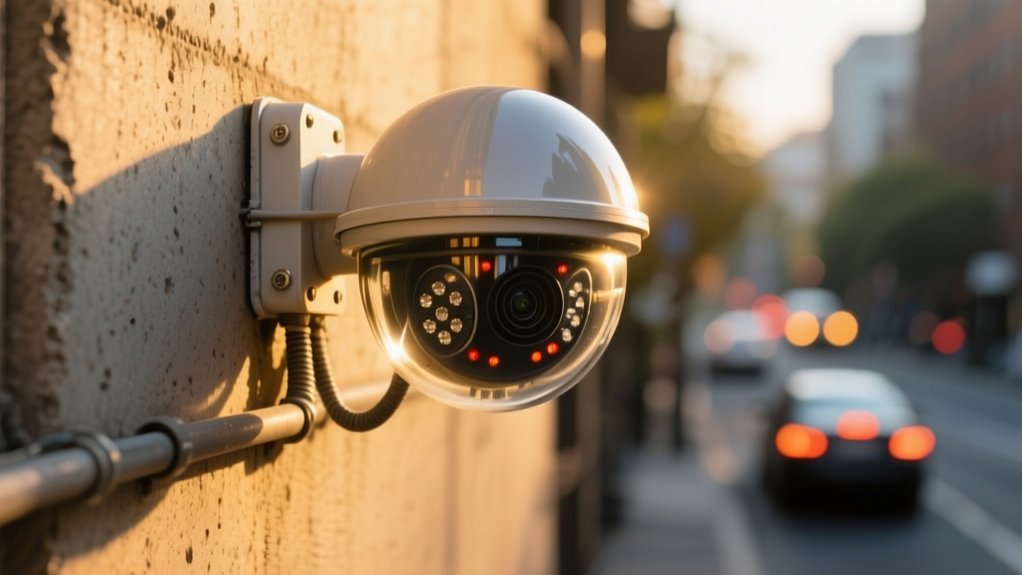
How Does a CCTV Camera Work?
A CCTV camera works by capturing light through a lens and converting it into electrical signals via a CCD or CMOS sensor. It transmits this video data in real time over wired or wireless connections to a monitor or recording device, like a DVR or NVR, where footage is stored and analyzed.
Advanced features include infrared night vision and motion detection for improved security. Understanding the underlying technology and transmission methods will help you choose the right system for your needs.
Key Takeaways
- CCTV cameras capture video by converting light into electrical signals using image sensors like CCD or CMOS.
- The video footage is transmitted via wired or wireless methods to monitors or recording devices in real-time.
- Recorded footage is stored digitally on DVRs or NVRs, often compressed to optimize storage space and duration.
- Cameras feature technologies such as infrared night vision and motion detection to enhance surveillance capabilities.
- Strategic camera placement ensures comprehensive coverage, accounting for environmental factors and specific security needs.
What Is a CCTV Camera and Why Do You Need One?
A CCTV camera serves as a crucial security device that captures and transmits video footage to designated monitors, allowing you to surveil specific areas effectively. This security camera plays an essential role in surveillance and crime prevention, deterring approximately 60% of potential burglars when visible.
Modern CCTV systems improve your monitoring capabilities with high-definition resolution, infrared sensors, and color night vision. They ensure reliable 24/7 operation under varying lighting conditions.
Furthermore, these systems often integrate with smart home technology, granting you remote access and control via smartphones or computers.
Given the projected $18.3 billion market for wireless CCTV systems by 2030, investing in such technology is fundamental for robust security management and proactive crime prevention in both residential and commercial settings.
How Do CCTV Cameras Capture Video Footage?
When you monitor a space with a CCTV camera, it captures video by converting the light entering its lens into electrical signals via an image sensor. This process allows the camera to capture footage accurately and convert it into usable video data.
CCTV cameras are strategically placed to cover critical areas, guaranteeing thorough surveillance. The captured video data is transmitted in real-time to monitors or recording systems.
Strategic placement ensures CCTV cameras provide comprehensive surveillance with real-time video transmission to monitoring or recording devices.
You can rely on various storage devices to archive this footage for future access and analysis.
Key points include:
- Image sensors converting light into electrical signals for video data
- Real-time transmission via analog or digital systems
- Storage devices like DVRs and NVRs preserving footage for review
This technical process guarantees effective and reliable video capture.
How Do CCTV Cameras Convert Light Into Electronic Signals?
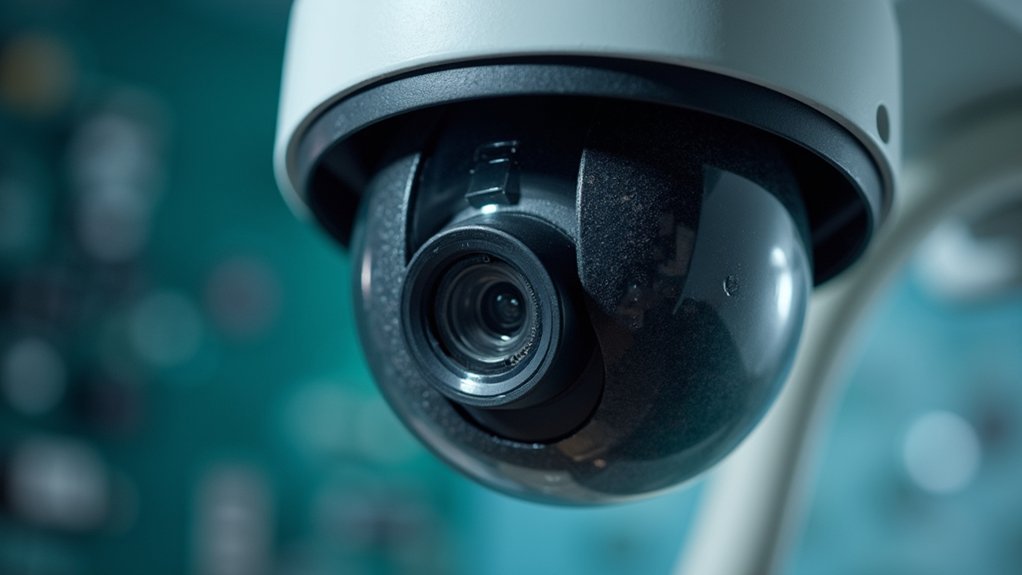
You’ll find that CCTV cameras use either CCD or CMOS sensors to convert incoming light into electronic signals.
They do this by focusing the light through a lens onto the sensor’s surface. Then, the sensor transforms the photons into electrical charges.
After that, these charges are processed and amplified to create a usable signal. Understanding this signal conversion is essential because it helps you grasp how the camera produces clear, digital images for monitoring and recording.
Image Sensor Functionality
Although invisible to the naked eye, the image sensor inside CCTV cameras plays an essential role by converting incoming light into electronic signals.
These signals enable video recording and transmission. The sensor, either CCD or CMOS, captures photons and generates an analog signal proportional to light intensity. This analog signal forms the basis for further processing into a digital signal, which is essential for modern surveillance systems.
Key aspects of image sensor functionality include:
- CCD sensors provide superior image quality and low-light sensitivity, ideal for high-resolution monitoring.
- CMOS sensors offer faster processing and lower power consumption, commonly used in cost-effective applications.
- Both sensors detect infrared light, allowing CCTV cameras to function effectively in low-light or night conditions.
Understanding this mechanism clarifies how CCTV cameras efficiently transform light into actionable electronic data.
Signal Conversion Process
Because CCTV cameras rely on accurate signal conversion, they focus incoming light through a lens onto a CCD or CMOS sensor. This sensor then generates an electrical charge proportional to the light’s intensity.
This sensor transforms the optical input into an electronic signal, representing the scene’s luminance and color data. The camera’s internal circuitry processes this electronic signal, converting it into a digital format suitable for further manipulation.
During this stage, image processing techniques such as noise reduction and signal improvement optimize the footage quality. Finally, the refined electronic signal transmits via coaxial cables or digital networks to recording devices or monitors.
Understanding this signal conversion process is essential, as it directly impacts the clarity and fidelity of the CCTV cameras’ footage. This ensures reliable surveillance and accurate visual documentation.
Types of CCTV Cameras
You’ll come across several types of CCTV cameras, each designed for particular surveillance needs.
For example, dome and bullet cameras have different coverage patterns that suit various settings.
Then there are PTZ cameras, which let you control the camera’s movement to track activity dynamically.
On top of that, some cameras come with special features like night vision, wireless connectivity, and thermal imaging, making it easier to monitor different environments effectively.
Camera Types Overview
CCTV cameras come in several specialized types, each designed to address specific surveillance requirements. Understanding these camera types helps you refine your surveillance system for efficiency and coverage. You’ll encounter:
Dome cameras: Ideal for wide-angle coverage in open spaces, blending discreetly into environments.
Bullet cameras: Engineered for long-range monitoring, offering focused surveillance for specific areas.
PTZ cameras: Allow remote pan, tilt, and zoom controls, enabling detailed observation of dynamic scenes.
Additionally, many CCTV cameras incorporate night vision capabilities to maintain visibility under low-light conditions.
Wireless IP cameras further improve installation flexibility by eliminating extensive wiring needs.
Selecting the right type guarantees your system performs effectively across varied environments and operational demands.
Specialized Camera Functions
Understanding the distinct capabilities of various camera types allows you to tailor your surveillance setup to specific monitoring needs.
In CCTV solutions, specialized camera functions optimize performance: bullet cameras provide long-range, focused imaging for detailed distant views, ideal for perimeter security.
Night vision cameras utilize infrared technology, guaranteeing effective surveillance in low-light or nighttime conditions.
PTZ cameras improve versatility by allowing remote pan, tilt, and zoom control, enabling dynamic tracking of moving subjects.
Moreover, dome cameras cover wide angles, suitable for expansive areas like retail spaces.
When combined, these specialized functions enable you to design a thorough system that addresses diverse security challenges efficiently, balancing coverage, detail, and adaptability.
Understanding these capabilities guarantees your CCTV deployment meets precise operational requirements.
How Do CCTV Cameras Transmit Video Signals?
Although video transmission methods vary, they all serve the purpose of delivering clear footage from the camera to storage or monitoring devices. CCTV cameras transmit video signals using distinct technologies tailored to system types.
Video transmission methods differ but consistently ensure clear footage delivery to storage or monitoring systems.
Wired analog cameras use coaxial cables to send footage directly to a Digital Video Recorder (DVR). Digital systems employ Ethernet cables, often linked to Network Video Recorders (NVRs), enhancing transmission quality.
Wireless CCTV cameras convert video signals into digital data, transmitting via short-range wireless signals to receivers or cloud storage.
Key factors influencing transmission quality include camera type, signal stability, and distance. Furthermore, compressed video codecs optimize bandwidth without compromising clarity.
To summarize:
- Wired transmission routes video to DVR/NVR units
- Wireless CCTV relies on digital signal conversion and wireless links
- Compression techniques maintain quality while reducing data load
Wired vs Wireless CCTV Camera Transmission Methods
You’ll find that wired CCTV systems transmit video through coaxial or Ethernet cables. This setup ensures a stable and uninterrupted signal, which is perfect for continuous monitoring.
On the other hand, wireless systems rely on short-range signals. These can sometimes face interference and usually need a reliable internet connection to work smoothly.
Knowing how these transmission methods operate can really help you figure out which one fits your installation environment and reliability needs best.
Wired Transmission Overview
When you choose wired CCTV cameras, you transmit video footage through coaxial or Ethernet cables directly to a DVR or NVR, which guarantees stable and reliable connections.
Wired transmission offers distinct advantages over wireless methods, including resistance to interference and consistent video quality. However, installation requires careful planning to route cables effectively.
Key benefits of wired CCTV cameras include:
- Stable connections with minimal signal loss, ensuring clear video footage.
- Higher resolutions and frame rates supported by direct links to the digital video recorder.
- Long-term reliability and reduced maintenance costs despite higher initial installation complexity.
Wireless Signal Challenges
Wired CCTV cameras deliver consistent video signals through physical cables, but wireless systems rely on short-range radio frequencies to transmit footage to a central receiver. You’ll find wireless systems more flexible during installation, yet they face challenges like interference and signal loss. This is especially true in complex installation environments.
A stable connection is critical to reliably transmit video footage; any disruption can degrade performance or cut off feeds entirely.
| Aspect | Wired CCTV |
|---|---|
| Transmission | Physical cables |
| Signal Stability | High, minimal interference |
| Installation | Limited by cable routing |
| Vulnerabilities | Low |
Wireless systems trade cable limitations for susceptibility to interference, signal loss, and hacking risks. This makes them less reliable but easier to install.
How Do CCTV Systems Store Video Footage?
Although CCTV cameras continuously capture video, the critical task lies in how they store this footage for later review. CCTV systems use either Network Video Recorders (NVR) for digital cameras or Digital Video Recorders (DVR) for analog setups to process and save video footage.
Storage can be local or cloud-based, balancing accessibility and security. Compression algorithms like H.264 or H.265 optimize storage efficiency without sacrificing quality.
When managing storage, consider these factors:
- Storage duration typically ranges from 30 to 90 days, adjustable based on capacity and needs.
- Required capacity depends on camera resolution, frame rate, and camera count.
- Cloud storage offers remote access and backup, complementing local NVR/DVR storage.
Understanding these elements guarantees efficient video storage management in your CCTV system.
The Role of Monitors and Recording Devices in CCTV Systems
After understanding how CCTV systems store video footage, it’s important to recognize the role monitors and recording devices play in the overall surveillance setup.
Monitors display live surveillance footage, allowing you to observe multiple camera feeds simultaneously from one location.
Recording devices, such as Digital Video Recorders (DVRs) or Network Video Recorders (NVRs), capture and store this footage securely for later retrieval and analysis.
Video management software (VMS) integrates with these devices, organizing video files and providing analytical tools that improve incident review efficiency.
Proper synchronization between monitors and recording devices guarantees continuous surveillance and assures that recorded footage remains accessible for evidence collection.
You rely on this combination to maintain real-time awareness and preserve critical data within a thorough CCTV system.
How Does Night Vision Work in CCTV Cameras?
How exactly do CCTV cameras capture clear images in complete darkness? They rely on night vision technology, primarily using infrared technology to detect light invisible to the human eye. This allows the camera to produce clear images even in low-light conditions.
Key components include:
- Infrared LEDs that illuminate an area without visible light, enabling detailed footage up to 30 meters.
- Automatic switching between day and night modes to optimize sensor sensitivity based on ambient light.
- Advanced systems using thermal imaging, which detect heat signatures rather than relying on reflected light, enhancing visibility in total darkness or adverse weather.
You should note that lens quality, resolution, and environmental interference can impact the effectiveness of night vision in CCTV cameras, influencing the clarity and reliability of the captured images.
How Does Motion Detection Work in CCTV Cameras?
When you set up a CCTV camera, motion detection plays an essential role in activating recording or alerts by sensing environmental changes. Most security cameras use passive infrared sensors that detect heat emitted by moving objects within the camera’s field of view.
This heat detection improves accuracy by distinguishing living beings from static backgrounds. You can adjust the sensitivity to minimize false alarms caused by irrelevant movements like swaying trees or passing vehicles.
Furthermore, smart motion detection algorithms analyze detected motion to differentiate humans, vehicles, and other objects, refining alert relevance. Many systems let you define specific zones within the field of view, focusing monitoring on critical areas while ignoring unimportant regions.
Together, these features optimize motion detection performance and elevate your CCTV system’s effectiveness.
How Does Remote Viewing Work With Modern CCTV Systems?
Motion detection triggers alerts and recordings, but accessing those moments remotely requires a different mechanism.
Remote viewing in modern CCTV systems relies on internet connectivity. This lets you monitor live feeds and recorded footage via smartphones, tablets, or computers. Most IP-based cameras integrate effortlessly with your network through Wi-Fi or Ethernet.
Key components include:
- Video management software (VMS) lets you handle multiple camera feeds simultaneously for efficient surveillance.
- Cloud storage provides secure, offsite access and backup of your footage anytime, anywhere.
- Robust security solutions such as encryption and password protection safeguard remote access against unauthorized use.
Top Factors That Impact CCTV Camera Performance
Several critical factors determine the performance of your CCTV camera, directly affecting its ability to deliver clear, reliable surveillance footage.
First, the resolution is paramount; a minimum of 1080p guarantees detailed imagery essential for accurate identification.
The lens type impacts your camera’s field of view and focus range. Wide-angle lenses cover broader areas, while telephoto lenses capture distant details.
Lighting conditions also influence performance; cameras with infrared or low-light capabilities maintain visibility during night or poor light.
The transmission method affects video stability and clarity, with coaxial cables supporting analog feeds and secure internet connections enabling IP-based streaming.
Finally, environmental factors such as weather and obstructions demand weather-resistant enclosures (IP67+) and strategic placement to preserve operational integrity and image quality under diverse conditions.
Choosing the Best CCTV Camera for Your Security Needs
How do you select the ideal CCTV camera tailored to your security needs? Start by analyzing your surveillance requirements and environment to choose the appropriate type, whether dome, bullet, or PTZ.
Prioritize models with at least 1080p resolution for sharp, actionable footage. Infrared technology is crucial for continuous monitoring in low-light or no-light scenarios.
Finally, evaluate storage options, balancing cloud accessibility against local storage immediacy.
- Match CCTV cameras to specific surveillance requirements and vulnerable areas.
- Ascertain infrared technology supports 24/7 visibility.
- Select storage options aligned with your access and retrieval priorities.
Frequently Asked Questions
How Long Do CCTV Cameras Typically Last Before Needing Replacement?
CCTV cameras typically last between 5 to 10 years before you need to replace them, but that’s not a fixed rule.
While high-end models with regular maintenance might serve you well beyond a decade, cheaper units exposed to harsh conditions could fail much sooner.
You’ll want to balance environmental factors, build quality, and upkeep.
Plus, even if your camera still works, tech improvements might push you to upgrade sooner for better performance.
Can CCTV Cameras Be Hacked or Compromised by Unauthorized Users?
Yes, CCTV cameras can be hacked if you don’t secure them properly.
If you leave default passwords unchanged or connect the system to unsecured networks, unauthorized users can exploit vulnerabilities.
Many cameras use encryption, but improper implementation weakens security.
You must regularly update firmware, use strong, unique passwords, and configure network settings carefully to reduce hacking risks and protect your footage from unauthorized access or manipulation.
What Are the Legal Restrictions on CCTV Camera Placement in Public Areas?
Imagine you install cameras in a public park without clear signage; you risk violating laws like Europe’s GDPR, which requires informing people about surveillance and data use.
Legally, you must restrict placement to areas where security justifies monitoring, avoid private spaces, and post visible notices.
These rules guarantee transparency and privacy, preventing legal challenges.
How Do Weather Conditions Affect CCTV Camera Functionality?
Weather conditions directly impact your CCTV camera’s functionality. Rain, snow, and fog reduce image clarity and IR illumination range, impairing visibility.
Low temperatures cause lens condensation, blurring footage, while extreme heat risks internal malfunctions.
Although IP67-rated enclosures protect your camera, you still need regular maintenance to clear debris or ice that obstructs views.
To maintain peak performance, you must clean lenses frequently and consider environmental challenges when positioning your cameras.
Are There Any Health Concerns Associated With CCTV Camera Infrared Lights?
You’re unlikely to face health risks from CCTV infrared lights, as they emit IR radiation between 700 nm and 1,000 nm, wavelengths deemed safe by regulatory bodies like the ICNIRP.
Studies show IR levels from these cameras are notably below harmful thresholds, with exposure far less intense than sources causing thermal damage.
Conclusion
Now that you understand how CCTV cameras transform light into electronic signals and deliver real-time vigilance, you hold the key to a digital sentinel guarding your space. Like a watchful eye weaving through shadows, these systems decode motion and stream clarity, ensuring no detail escapes notice.
By choosing the right camera and optimizing its performance, you transform passive observation into active protection, turning technology into your steadfast shield against uncertainty.