How Does a Polaroid Camera Work?
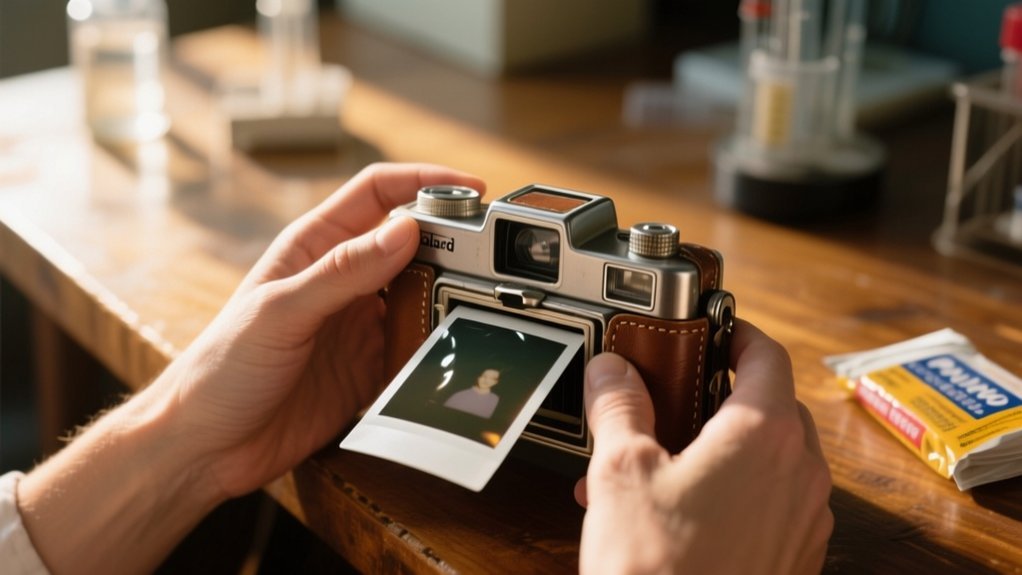
When you take a photo with a Polaroid camera, the film is instantly exposed to light, activating embedded chemicals. As the film ejects, rollers break chemical capsules, spreading the developer evenly to start a rapid reaction that forms the image within about 60 seconds.
This precise interplay between light-sensitive layers, dyes, and developer creates your picture quickly. You’ll find there’s more to how the camera’s components and storage impact photo quality and development speed.
Key Takeaways
- Polaroid cameras expose light-sensitive film coated with chemical layers to capture an image instantly.
- Upon ejection, rollers spread a developing agent evenly across the exposed film layers to start chemical reactions.
- The developing agent triggers dye molecules to migrate, forming the visible image within about 60 seconds.
- A clear plastic cover traps the developed image, preserving colors and contrasts from further exposure.
- Original packaging and proper storage protect the film’s chemicals, ensuring optimal image quality and functionality.
How Polaroid Film Develops Instantly

Although it happens within about 60 seconds, the development of Polaroid film involves a precise chemical process triggered by light exposure.
When you capture an image with instant cameras, the film emulsion containing sensitive dye molecules undergoes a chemical reaction initiated by light.
After exposure, rollers inside the camera spread the developing agent evenly across the film’s layers, activating the developing process. This agent reacts with the dye molecules in the film emulsion, causing them to migrate and form the visible image.
The reaction completes swiftly, fixing the colors and contrasts as the clear plastic cover traps the developed image.
Understanding this instantaneous chemical reaction is key to grasping how Polaroid cameras produce fully developed photos without external processing equipment.
What’s Inside a Polaroid Film Pack
Inside a Polaroid film pack, you’ll find a carefully engineered assembly of layers and components designed to facilitate instant photography.
The core includes light-sensitive film coated with multiple chemical layers. These chemical layers contain precise amounts of developing chemicals and chemical developers, sealed until exposure. A protective layer shields these chemicals, preventing premature reactions.
The film pack also integrates rollers that activate upon ejection from the camera. They break chemical seals and evenly spread the developing chemicals across the exposed film.
Furthermore, the pack features a mirror for accurate image reflection and contacts that connect to the camera’s battery, powering film advancement. A gear system guarantees each frame advances precisely, enabling one image at a time.
This intricate design allows the film pack to produce instant, high-quality photographs efficiently.
How Polaroid Rollers Trigger Film Development
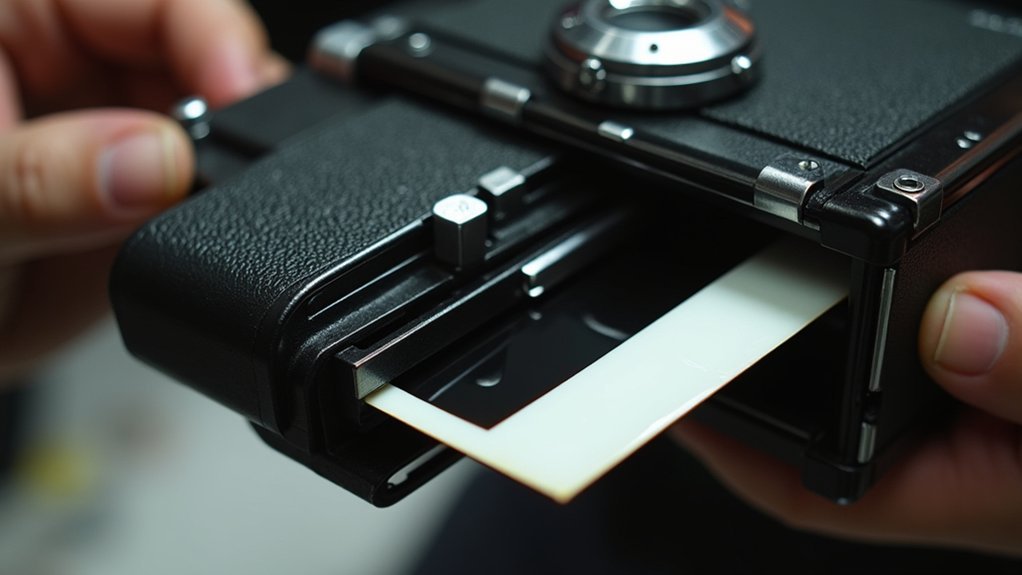
The rollers in a Polaroid camera play an essential role immediately after you take a photo, triggering the film development process. Here’s how these Polaroid cameras use rollers to initiate image development:
- As the film ejects, the rollers compress the built-in developer pod, breaking chemical seals within the film pack.
- This action evenly spreads the developing agent across the exposed film layers.
- The mixing of chemicals starts the chemical reaction necessary for image development.
- The rollers also advance the film sequentially, ensuring one image develops at a time.
This precise mechanical function guarantees rapid and consistent chemical distribution, enabling your photo to develop in about 60 seconds after exposure.
Chemical Reactions That Develop Polaroid Film
Once the rollers spread the developing agent, you’ll notice an instant chemical activation.
This activation triggers dye molecules within the film layers. The agent helps the dyes move just right, pushing opacifiers and metallic silver around to slowly create the visible image.
Instant Chemical Activation
Several layers within Polaroid film work together to initiate a rapid chemical process the moment light hits the emulsion. When you snap an instant camera photo, the dye developers embedded in the film activate immediately upon being exposed to light to develop the film.
Here’s how the instant chemical activation unfolds:
- Light excites dye molecules in the film emulsion.
- Excited dyes interact with the developing agent stored within the film.
- As the photo ejects, rollers spread the developing agent evenly across the layers.
- Chemical reactions form metallic silver and mobilize dyes to produce the visible image.
This precise, controlled chemical reaction sequence allows instant cameras to develop photos quickly and reliably. It captures moments as tangible images within about 60 seconds.
Dye Diffusion Process
Light-triggered chemical reactions drive the dye diffusion process in Polaroid film, enabling the formation of your instant image. When light exposes the film’s light-sensitive emulsion layer, it activates dye molecules embedded within.
The film’s multilayer structure, comprising the emulsion, developer pod, and protective layer, facilitates precise chemical interactions. As the developing agent spreads through these layers, it causes the excited dye molecules to migrate selectively, transferring cyan, magenta, and yellow dyes to the image layer.
This migration forms the visible image by varying dye concentrations according to the initial light exposure. Over roughly 60 seconds, opacifiers clear, revealing the final image.
The chemistry behind this process carefully controls dye movement within the film, allowing your Polaroid to instantly produce a full-color photograph through sophisticated, light-sensitive dye diffusion.
Role Of Developing Agent
The developing agent plays an essential role in transforming your Polaroid film from a light-exposed state into a visible image through a series of controlled chemical reactions.
When you capture a photo, this agent initiates a chemical reaction that activates the emulsion layers.
Here’s how it works: The developing agent spreads evenly across the instant film via rollers. It interacts precisely with dye molecules embedded in the emulsion layers.
This interaction facilitates the movement and combination of dyes to form the image. Within approximately 60 seconds, the reaction completes, producing a fully developed photograph.
Proper storage of the film before use guarantees the developing agent remains effective, maintaining the chemical reaction’s integrity and resulting image quality.
Why Polaroid Photos Develop in Under a Minute
You’ll notice Polaroid photos develop in under a minute because the film triggers an instant chemical reaction once it’s exposed to light.
Inside the camera, rollers spread the developing agent evenly across multiple layers of the film. This ensures the image forms quickly and uniformly.
It’s this precise mechanism that speeds up the whole process, letting the picture appear fast and consistently every time.
Instant Chemical Reaction
Because light activates the developing agent embedded within the film pack, Polaroid photos develop in under a minute through a carefully orchestrated chemical process.
In instant photography, the chemical reaction unfolds as follows:
- Light exposure triggers the film emulsion’s dye molecules within multiple film layers.
- The developing agent spreads chemicals that react with the exposed dye molecules.
- This reaction forms the visible image by selectively activating color dyes.
- Opacifiers in the film layers clear away, revealing the final photograph.
This rapid chemical reaction is precisely engineered to occur uniformly across the film layers, ensuring the image emerges quickly and vividly.
The interplay between the dye molecules, developing agent, and film emulsion is critical for the swift development characteristic of Polaroid instant photos.
Roller Spreading Mechanism
Light-triggered chemical reactions in Polaroid film rely on a precise distribution of developing agents immediately after exposure.
The roller spreading mechanism in a Polaroid Camera guarantees this by pushing the film through carefully engineered rollers that break chemical seals, releasing the developing agent.
This agent spreads evenly across the film emulsion, initiating the chemical reaction vital for image formation.
The rollers also regulate the timing layer, controlling the pace of the reaction to optimize image quality.
By coordinating the spread and activation of the developing agent, the mechanism assures that the entire development process completes in under a minute.
This precise mechanical and chemical coordination allows you to see a fully developed photo almost instantly after capture, highlighting the Polaroid Camera’s innovative integration of timing, chemistry, and mechanics.
How to Store Polaroid Film for Best Results
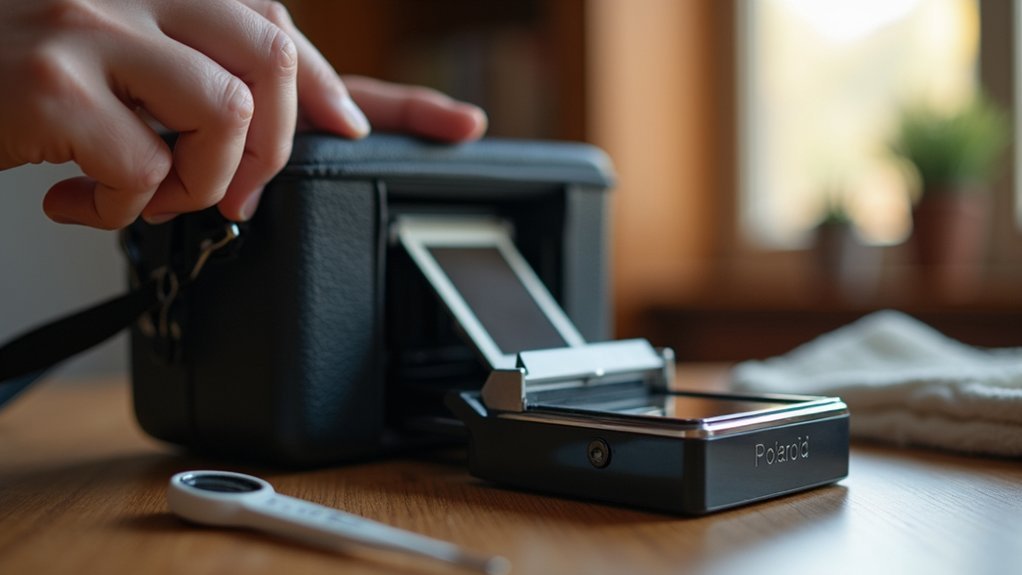
To preserve the chemical integrity and image quality of Polaroid film, follow five essential storage guidelines.
First, always store Polaroid film in its original packaging to shield it from light and moisture, which can compromise the film’s chemical layers.
Store Polaroid film in its original packaging to protect it from light and moisture damage.
Second, maintain ideal storage conditions between 55-70°F (13-21°C) to prevent premature chemical degradation.
Third, avoid humid environments; excess moisture accelerates film deterioration and can blur images.
Fourth, keep the film away from direct sunlight to prevent fading and chemical breakdown.
Finally, monitor the expiration date closely. Using the film before it expires guarantees prime chemical reactivity and image quality.
Frequently Asked Questions
Can I Use Expired Polaroid Film Safely?
Yes, you can use expired Polaroid film safely, but expect less vibrant colors and possible fading.
To get the best results, try to use the film within a year of its expiration date. Also, store it in a cool, dry place before shooting.
Make sure to inspect each pack carefully for any damage. You might need to adjust your camera settings or lighting to make up for the film’s reduced sensitivity.
Keep in mind that older or compromised film can produce unpredictable or even failed images.
How Do I Clean My Polaroid Camera Lens?
To clean your Polaroid camera lens, first power off the camera and remove any film pack.
Use a microfiber cloth slightly dampened with lens cleaner or water to gently wipe the lens in circular motions.
Avoid paper towels or rough fabrics, as they can scratch the lens.
Apply minimal pressure to remove smudges without damaging the surface.
Regular cleaning guarantees peak image quality and prevents dirt buildup that can affect your photos.
What Causes Polaroid Photos to Fade Over Time?
Think of your Polaroid photo as a delicate garden.
Over time, sunlight acts like harsh rays, moisture like unexpected rain, and extreme temperatures like wild storms. All these break down the garden’s vibrant flowers, the dyes.
These environmental factors speed up chemical reactions that degrade image quality.
To protect your photo’s colors, store it cool (55-70°F), dry, and away from light.
Handling it gently keeps the chemical layers intact and preserves your picture’s life.
Are There Digital Polaroid Cameras Available?
Yes, digital Polaroid cameras are available, like the Polaroid Snap and Snap Touch.
You’ll capture high-resolution images, around 10 megapixels, and print them instantly on ZINK paper.
The Snap Touch even lets you preview and edit photos on its touchscreen before printing.
These cameras combine digital tech with classic instant prints, and some models offer Bluetooth for mobile printing.
You can also use devices like the Polaroid Lab to turn digital photos into physical prints.
How Do I Recycle Used Polaroid Film Cartridges?
Did you know that nearly 90% of a Polaroid film cartridge’s plastic can be recycled?
To recycle your used cartridges, first check for a recycling symbol and local guidelines. Many waste facilities accept them, but chemical residues require special handling to avoid contamination.
Some companies even offer take-back programs.
Always separate plastic parts and dispose of chemical components per local regulations to guarantee safe, environmentally responsible recycling.
Conclusion
Think of your Polaroid camera as a tiny, intricate factory, where each photo is a carefully crafted masterpiece born in moments. As you press the shutter, rollers squeeze out a chemical symphony that dances across the film, developing your image with precision and speed.
Like a delicate alchemist’s touch, this process transforms invisible layers into vivid memories. By understanding and caring for your film, you guarantee every snapshot captures time’s fleeting magic flawlessly.