How Did the Camera Obscura Record a Picture?
Long before modern cameras and digital screens, people searched for ways to capture the world exactly as the eye sees it. Light, shadow, and shape became tools for understanding reality, not just elements of art. This curiosity led to one of the most important optical discoveries in history.
Artists, scientists, and philosophers noticed that light passing through a small opening could project scenes with surprising accuracy. Walls turned into silent witnesses of moving streets, landscapes, and faces. This simple observation slowly transformed into a powerful visual method.
The question of how did the camera obscura record a picture connects science with human wonder. The device did not store images the way film or sensors do today. Instead, it relied on light traveling in straight lines to create a natural projection of the outside world.
By exploring this process, the camera obscura reveals how vision, physics, and creativity intersect. Its story explains how images were observed, studied, and traced, laying the foundation for photography and changing how people understood visual reality.
How Did the Camera Obscura Record a Picture?
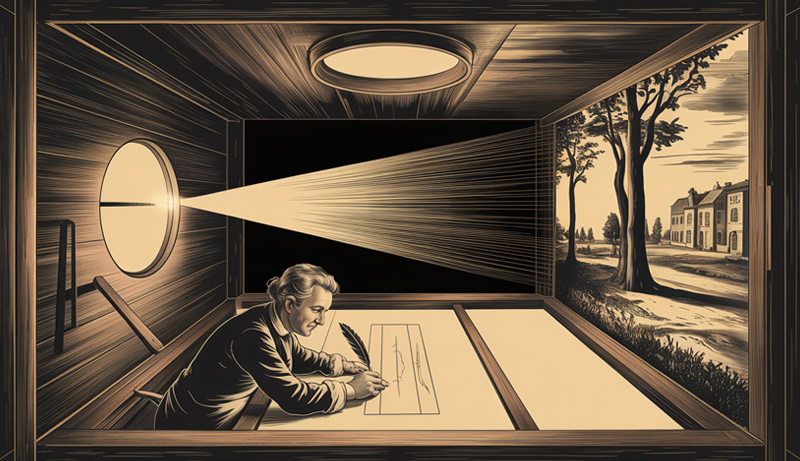
The process of how did the camera obscura record a picture begins with a basic principle of light. When light reflects off objects, it travels in straight lines. If that light passes through a very small hole in a darkened space, it projects an image of the outside scene onto the opposite surface. This projected image appears inverted and reversed, yet remarkably detailed.
Inside the camera obscura, darkness is essential. By blocking out all other light sources, the device ensures that only light entering through the tiny aperture forms the image. The small size of the opening helps sharpen the projection, allowing outlines, movement, and perspective to appear clearly on the interior wall or screen.
The camera obscura did not permanently store images on its own. Instead, it recorded a picture by projection. Artists and observers would often place paper or canvas over the projected image and trace what they saw. This method allowed scenes to be captured with accurate proportions and realistic depth.
Lenses were later added to improve brightness and clarity. With a lens, more light could enter without sacrificing sharpness, making the projected image easier to observe and trace. Some versions also used mirrors to flip the image upright, making it more practical for drawing and study.
Understanding how did the camera obscura record a picture explains why it became so influential. It offered a direct visual link between the real world and image-making. This simple optical tool shaped artistic techniques and scientific observation, ultimately paving the way for the invention of photography and modern cameras.
What Is a Camera Obscura?
A camera obscura is an early optical device that demonstrates how light forms images. The term comes from Latin, meaning “dark chamber.” At its simplest, it consists of a darkened room or enclosed box with a small hole (or aperture) on one side. When light from an outside scene passes through this tiny opening, it projects an image onto the opposite interior surface.
The projected image appears upside down and reversed. This happens because light travels in straight lines, crossing at the small opening before spreading out again inside the dark space. Despite its simplicity, the image can show accurate shapes, movement, perspective, and relative scale.
Camera obscuras were known and studied for centuries by scientists, philosophers, and artists. Some versions were large enough to walk into, while others were portable boxes. Over time, lenses and mirrors were added to improve brightness and orientation.
Most importantly, the camera obscura did not capture images permanently. It displayed them in real time, allowing people to observe or trace what they saw. This principle became the foundation for photography and modern camera technology.
How the Camera Obscura Works (Step-by-Step)
Understanding how camera obscura works begins with recognizing its reliance on basic optical laws rather than mechanical complexity. The device uses controlled darkness and a carefully sized opening to guide light into an enclosed space. Through this simple setup, real-world scenes are transformed into visible images using pinhole projection and inverted image optics, demonstrating how light naturally forms pictures without electronic or chemical processing.
Light Entry Through a Small Aperture
The first step in pinhole projection is the entry of light through a very small opening, commonly called an aperture. This aperture can be a simple pinhole or a glass lens added to improve brightness and clarity. As light reflects off objects outside, it travels in straight lines toward the opening. Only a narrow bundle of light rays from each point on the object can pass through the small aperture.
The role of the pinhole is to limit how much light enters the dark space. By restricting light rays, the camera obscura prevents excessive overlap of rays inside the chamber. This control is essential for forming a recognizable image rather than a washed-out blur. A lens performs a similar function but bends and concentrates light more efficiently, allowing a brighter projection while maintaining focus.
Smaller openings produce sharper images because they reduce the angle at which light rays spread after entering. When the aperture is large, light rays from different points overlap too much, causing image softness. A smaller pinhole narrows these paths, preserving edge definition and detail. This trade-off results in increased sharpness but reduced brightness.
The balance between aperture size and image clarity is central to how camera obscura works. While very tiny openings create crisp images, they require strong external light to remain visible. This relationship between light control and image formation later became fundamental in photographic lens design.
Image Projection Inside the Dark Space
Once light passes through the aperture, it enters the dark interior of the camera obscura and begins forming an image. Inside this space, light rays from the top of an object travel downward through the opening, while rays from the bottom travel upward. This crossing of light paths is what produces the inverted image optics characteristic of the camera obscura.
The image appears upside down and reversed because of the way light travels in straight lines. Each point on the object sends rays in multiple directions, but only a narrow set can pass through the small opening. When these rays cross, their spatial orientation flips. This natural inversion occurs without mirrors or mechanical manipulation.
Distance also plays a role in image projection. The farther the projection surface is from the aperture, the larger the projected image becomes. However, increased size can reduce brightness and sharpness. Early users learned to adjust interior dimensions to balance scale and clarity.
The dark environment inside the chamber is critical. Any stray light would interfere with the projected rays and reduce contrast. Complete darkness ensures that the projected scene stands out clearly against the background surface. This principle explains why enclosed boxes or sealed rooms were essential to pinhole projection.
Through this controlled crossing of light rays, the camera obscura demonstrates inverted image optics in a direct and observable way, making abstract optical theory visible to the human eye.
Viewing the Projected Image
The final step in how camera obscura works involves viewing the projected image on an interior surface. This surface could be a wall, a sheet of paper, cloth, or a specially prepared translucent screen. As light rays strike the surface, they recreate the external scene in real time, complete with movement, depth, and perspective.
Visibility depends heavily on lighting conditions outside the camera obscura. Bright daylight produces clearer and more vibrant projections, while low-light conditions result in faint images. The darker the interior space, the easier it is to see the projection. This contrast is essential for distinguishing fine details and outlines.
The surface texture also affects image quality. Smooth, light-colored surfaces reflect projected light evenly, improving clarity. Rough or dark surfaces absorb light and reduce image definition. For this reason, many users prepared white screens to enhance visibility.
Observers could view the image directly or trace it for artistic and scientific purposes. Because the image was a projection rather than a permanent record, its existence depended entirely on continuous light entry. Movement outside appeared instantly inside, making the camera obscura a live visual tool.
This method of viewing emphasizes the relationship between light intensity, surface quality, and perception. It highlights how pinhole projection relies not only on optics but also on environmental control to make inverted image optics clearly visible.
Did the Camera Obscura Actually Record Images?
The question of did camera obscura take photos often leads to confusion because the device created images without preserving them. The camera obscura was designed to project visual scenes, not to store them. This distinction between projecting and recording is essential to understanding its historical role. On its own, the camera obscura could display images clearly, but it lacked the ability to permanently capture them.
How Artists Used the Camera Obscura
Although the camera obscura could not record images by itself, artists found practical ways to use it as a visual aid. One of the most common techniques was camera obscura tracing, where artists placed paper or canvas over the projected image. By tracing outlines, shadows, and proportions, they could recreate scenes with remarkable accuracy. This method allowed artists to work directly from real-world visuals rather than memory or imagination alone.
The projected image helped solve long-standing challenges in drawing, especially perspective and scale. Buildings, landscapes, and interiors could be rendered with correct vanishing points and spatial depth. This was particularly useful during periods when realistic representation was highly valued. The camera obscura provided a reliable reference for proportions that were difficult to judge by eye.
Artists also benefited from observing light behavior. The projection showed natural shadows, highlights, and tonal transitions, improving realism in finished works. Moving subjects, such as people or animals, appeared in real time, allowing artists to study motion and posture.
Despite its usefulness, the camera obscura remained a temporary tool. Once the light source disappeared, so did the image. The final artwork existed only because of the artist’s manual effort, not because the device itself recorded anything permanently.
When Recording Became Possible
True early image recording began only when light-sensitive materials were introduced. Scientists and inventors discovered substances that reacted chemically to light exposure. When placed where the camera obscura projected an image, these materials could retain visual information without the need for tracing.
This breakthrough marked a critical transition toward photography. Instead of relying on human observation and manual reproduction, images could now be fixed automatically. Early experiments involved coated plates and treated surfaces that darkened when exposed to light. However, initial attempts were unstable, and images often faded quickly.
Over time, improvements in chemical processes made image preservation more reliable. The camera obscura concept was combined with these materials, transforming the device from a viewing tool into a recording instrument. The dark chamber, aperture, and projection principles remained the same, but the outcome changed dramatically.
This shift redefined the purpose of image-making. What began as a method for studying light and assisting artists evolved into a system capable of capturing reality permanently. The distinction between projection and recording explains why the camera obscura itself did not take photos, yet played a crucial role in the development of photographic technology.
Materials Used With Camera Obscura for Image Capture
Materials used with the camera obscura evolved as people searched for ways to move from temporary projection to image capture. In its earliest use, no special recording material was involved at all. The device simply projected an image onto a surface, relying entirely on human observation rather than physical preservation.
One of the first practical materials was ordinary paper or canvas. Artists placed these surfaces inside the camera obscura and traced the projected scene by hand. While this did not truly capture light, it allowed images to be transferred with accurate proportions and perspective, making the material an indirect recording medium.
Ground glass and translucent screens were also commonly used. These materials did not preserve images, but they improved visibility by diffusing light evenly. The projected image appeared clearer and easier to observe, especially in portable camera obscura boxes designed for drawing and study.
True image capture began when light-sensitive substances were introduced. Early experiments used silver salts, which darkened when exposed to light. When placed where the camera obscura projected an image, these materials reacted chemically, allowing parts of the image to remain after exposure.
Other materials, such as bitumen-based coatings and treated metal or paper surfaces, further advanced image capture. These substances hardened or changed tone under light, making early image recording possible. Although slow and imperfect, they marked the transition from observation to preservation.
Together, these materials transformed the camera obscura from a visual aid into a foundation for photographic processes, demonstrating how chemistry and optics combined to make permanent images possible.
Camera Obscura vs Modern Cameras
| Feature | Camera Obscura | Modern Cameras |
|---|---|---|
| Basic Function | Projects a real-time image using light and a small aperture | Captures and stores images using lenses, sensors, and electronics |
| Image Recording | Does not permanently record images on its own | Permanently records photos and videos |
| Light Control | Uses a pinhole or simple lens | Uses adjustable lenses, apertures, and shutters |
| Image Orientation | Produces inverted and reversed images | Produces correctly oriented images automatically |
| Recording Medium | Requires manual tracing or external materials | Uses digital sensors or photographic film |
| Image Quality | Limited sharpness and brightness | High resolution with advanced image processing |
| Portability | Often bulky or room-sized (early versions) | Highly portable, including smartphones |
| Automation | Fully manual operation | Automatic focus, exposure, and processing |
| Speed | Real-time projection only | Instant image capture and storage |
| Purpose | Observation, study of optics, artistic aid | Photography, videography, documentation, and communication |
Why the Camera Obscura Was Important in Photography History
The camera obscura was important in photography history because it established the core principle behind all image-making devices: light can form images. Long before photographs existed, the camera obscura proved that scenes from the real world could be visually reproduced with accuracy using controlled light. This discovery laid the scientific and conceptual groundwork for photography.
One of its greatest contributions was demonstrating how images form naturally through optics. By showing that light travels in straight lines and can project an inverted image, the camera obscura helped scholars understand visual perception. These insights directly influenced the development of lenses, apertures, and exposure control, all of which are fundamental to photography.
The camera obscura also bridged art and science. Artists used it to achieve realistic perspective, proportions, and lighting, shaping visual standards that photography would later inherit. When photography emerged, it followed the same visual logic already familiar through camera obscura projections, making early photographs easier to understand and accept.
Most importantly, the camera obscura provided the structural model for early cameras. When light-sensitive materials were introduced, inventors did not need to reinvent image formation—they simply combined chemistry with the existing dark chamber design. This seamless transition accelerated photographic innovation.
Because of these contributions, the camera obscura stands as the missing link between human observation and mechanical image capture, making it a cornerstone in the history of photography.
Common Misconceptions About the Camera Obscura
Many people assume the camera obscura was an early form of a modern camera, but this is one of the most common misconceptions. While it shares basic optical principles with today’s cameras, the camera obscura did not function as a photo-taking device. It created projected images, not permanent records, which makes its role very different from photographic technology.
Another misunderstanding is the belief that the camera obscura could capture images automatically. In reality, it relied entirely on light projection. Any lasting image required human involvement, such as tracing the projection by hand or later adding light-sensitive materials. Without these external methods, the image disappeared as soon as the light source changed.
Some people also think the camera obscura always used a lens. Early versions relied only on a small pinhole to form images. Lenses were added much later to improve brightness and clarity, but they were not essential to the device’s basic function.
There is also confusion about image quality. Many assume the camera obscura produced blurry or crude visuals. In fact, under proper lighting and with a correctly sized aperture, the projected image could be sharp, detailed, and highly accurate in perspective.
Another misconception is that the camera obscura was mainly a scientific curiosity. While scientists studied it, artists widely used it as a practical tool for improving realism and perspective in drawings and paintings.
Finally, some believe the camera obscura became irrelevant once photography emerged. In truth, its principles remain active in modern cameras, proving its lasting importance in visual technology.
Frequently Asked Questions (FAQs)
How Did the Camera Obscura Record a Picture?
The camera obscura did not record a picture in the modern sense. Instead, you would see a real-time projection formed by light entering through a small aperture. The image appeared on an interior surface but disappeared when light conditions changed. Any “recording” depended on you tracing the projection or later using light-sensitive materials.
Did the Camera Obscura Take Photos Like Modern Cameras?
No, the camera obscura did not take photos the way modern cameras do. You could view an image, but the device itself had no mechanism to permanently capture it. Unlike modern cameras that store images digitally or on film, the camera obscura only displayed images temporarily.
How Was an Image Formed Inside the Camera Obscura?
An image formed when light rays reflected off objects and passed through a small hole or lens into a dark space. As the rays crossed at the aperture, the image became inverted and reversed. You could clearly observe shapes, movement, and perspective on the projection surface.
How Did Artists Use the Camera Obscura to Record Images?
Artists used the camera obscura as a visual guide rather than a recording device. You would place paper or canvas over the projected image and trace outlines and shadows. This method helped improve accuracy, perspective, and realism, even though the final image was created by hand.
When Did the Camera Obscura Start Recording Images Permanently?
Permanent recording became possible only after light-sensitive materials were introduced. When you placed treated paper or plates inside the camera obscura, light reactions allowed parts of the image to remain. This development marked the transition toward early photography.
Why Is the Camera Obscura Still Important Today?
The camera obscura is important because it explains the foundation of how images form using light. When you understand how did the camera obscura record a picture through projection, you also understand the basic principles behind lenses, exposure, and modern camera systems still used today.
Conclusion
The camera obscura reveals how images existed long before modern photography. It showed that light alone could reproduce reality with precision, allowing people to observe the world in a new visual form. This simple dark chamber transformed curiosity about light into a practical optical tool.
Understanding how did the camera obscura record a picture requires recognizing that recording did not mean permanent capture. The device projected images in real time, relying on human tracing or later chemical materials to preserve what was seen. Its power came from projection, not storage.
By bridging observation, art, and science, the camera obscura became a foundation for photographic development. Its principles still guide modern cameras today, proving that even the simplest optical discoveries can shape centuries of visual technology and human understanding.