What Does a Red Light Camera Flash Do?
When you cross a stop line after the light turns red, a red light camera flash triggers to capture clear, high-contrast images of your vehicle and license plate. This flash guarantees sharp, well-lit photos that serve as accurate evidence of violations, especially in low-light conditions.
The system records video alongside these images for thorough documentation. Sometimes, flashes occur without violations, reflecting sensitive detection. Understanding this process helps improve your compliance with traffic signals and avoid penalties.
Further details explain how these flashes support traffic safety enforcement.
Key Takeaways
- The red light camera flash activates when a vehicle crosses the stop line after the light turns red to capture violation evidence.
- Flash enhances image clarity by improving contrast and reducing motion blur, especially in low-light conditions.
- It triggers a 12-second video recording that documents the violation before and after the incident.
- Flash ensures clear visibility of license plates and vehicle details for accurate citation processing.
- The flash deters risky driving behaviors by encouraging drivers to stop fully at red lights.
How Does a Red Light Camera Flash Trigger?
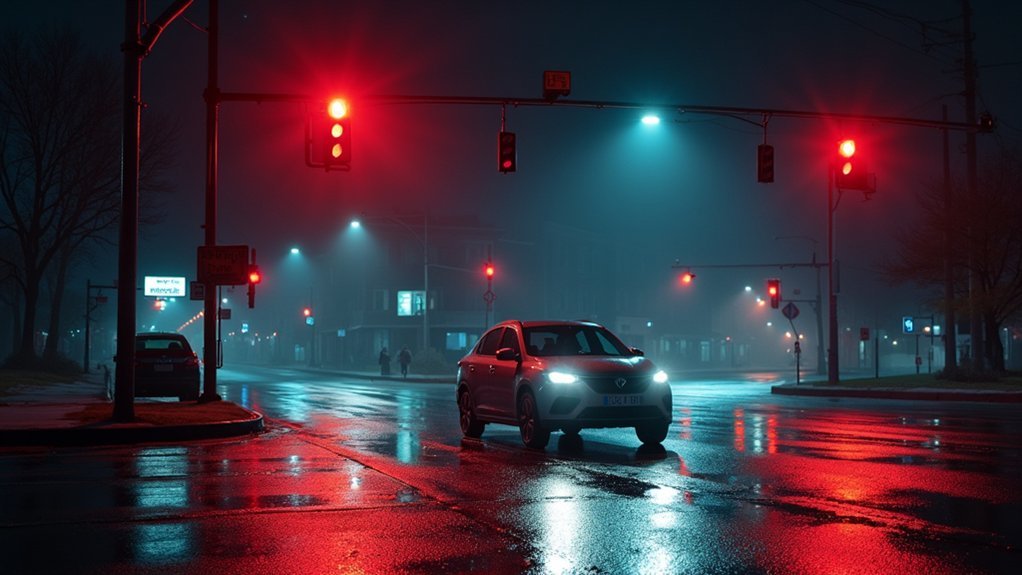
When a vehicle crosses the stop line after the traffic light turns red, the red light camera flash triggers to capture the violation accurately. Red light cameras activate when motion is detected within a short grace period, typically 0.3 seconds, after the traffic signal changes to red. This guarantees the violation event captured reflects a true infraction.
Moreover, if you make a right turn on red without a complete stop, the flash may also trigger. Not every violation event results in a citation; images of an alleged offense undergo a review process to confirm accuracy before a citation goes out.
The system’s reliability is demonstrated by over 80% accuracy in detecting excessive speed approaches, underscoring the precision of red light camera flashes in monitoring traffic signal compliance.
What Images Does the Red Light Camera Flash Capture?
When the red light camera flashes, it takes two pictures of your vehicle from the back. The first one is snapped right at the stop bar while the light is still red.
Then, it captures another image as you move through the intersection.
From these photos, the system zooms in on your license plate to identify your vehicle.
This way, the violation is documented accurately and clearly.
Rear Violation Images
Although the red light camera flash captures multiple images during a violation, it primarily takes two rear images of your vehicle: one at the white stop bar with the red light illuminated and another as you proceed through the intersection with the red light still on.
These rear violation images document your position relative to the stop bar and the illuminated red signal, providing clear evidence of the infraction.
The red-light camera system also records a 12-second digital video, capturing six seconds before and after the violation, enhancing context.
While the license plate image is derived from these violation images, no separate photo exclusively targets the plate.
The camera activates upon detecting motion just before the stop bar after the traffic signal turns red, ensuring accurate violation capture at the intersection.
License Plate Close-Ups
How does the red light camera capture close-up images of your license plate? The red light camera first records two rear images during a potential violation: one at the white stop line and another in the center of the intersection.
From these original images, the system generates a license plate close-up rather than taking separate photographs. Alongside these still images, the camera also records a 12-second digital video covering six seconds before and after the incident.
The flash activates when a vehicle crosses the stop line against the traffic signal, but it may also trigger without a violation, such as during a right turn without a full stop.
All images and video undergo Police Department review to confirm accuracy before a citation is issued based on the violation evidence.
When Does the Flash Activate During a Violation?
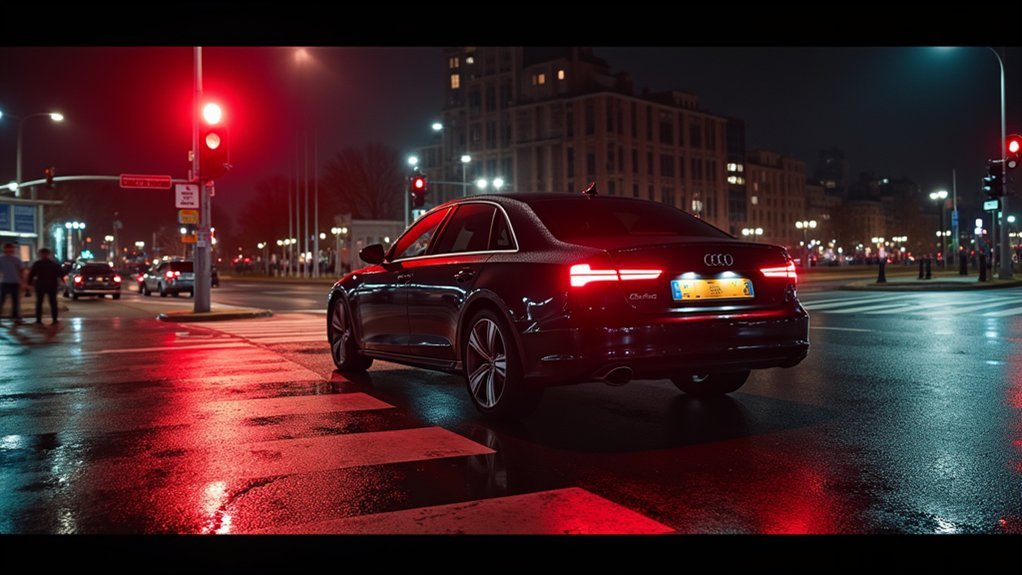
Because the red light camera relies on motion detection, its flash activates as soon as a vehicle enters the intersection after the traffic signal turns red. Red-light cameras capture two images during this violation: the first shows the vehicle at the white stop bar, and the second captures it in the intersection’s center.
The flash may also trigger if a vehicle stops just before the intersection or makes a right turn without a complete stop, though not all such instances lead to citations.
Moreover, the system records a 12-second video encompassing six seconds before and after the violation.
This precise flash activation guarantees clear photographic evidence of the vehicle violating the traffic signal, supporting lawful enforcement and enhancing intersection safety by encouraging drivers to stop appropriately.
Why Does the Flash Make Citation Photos Clearer?
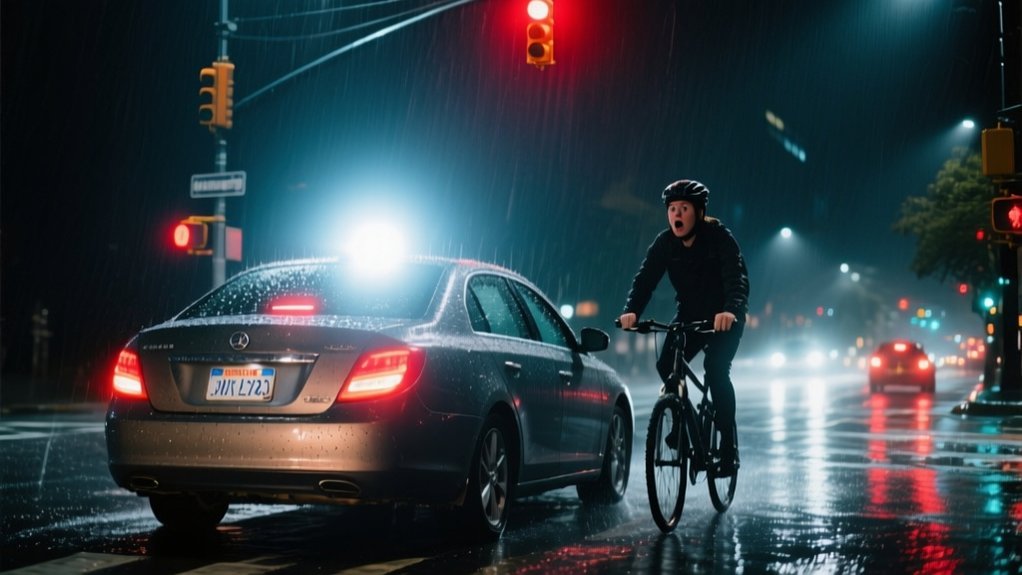
A red light camera’s flash plays an essential role in producing clear citation photos by illuminating the vehicle and its surroundings, especially under low-light or nighttime conditions. The flash increases contrast within the images, making the license plate and vehicle details stand out distinctly. This improved visibility is critical for identifying the vehicle accurately during a violation.
Moreover, the flash reduces motion blur caused by the vehicle’s movement, resulting in sharper images that precisely capture the vehicle’s position at the moment of the violation. By enhancing image clarity and detail, the flash guarantees the photographic evidence is reliable and verifiable.
Consequently, law enforcement can review violations more effectively, reinforcing the integrity of the evidence collected through red light camera systems.
How Do Red Light Cameras Record Video With Flash Images?
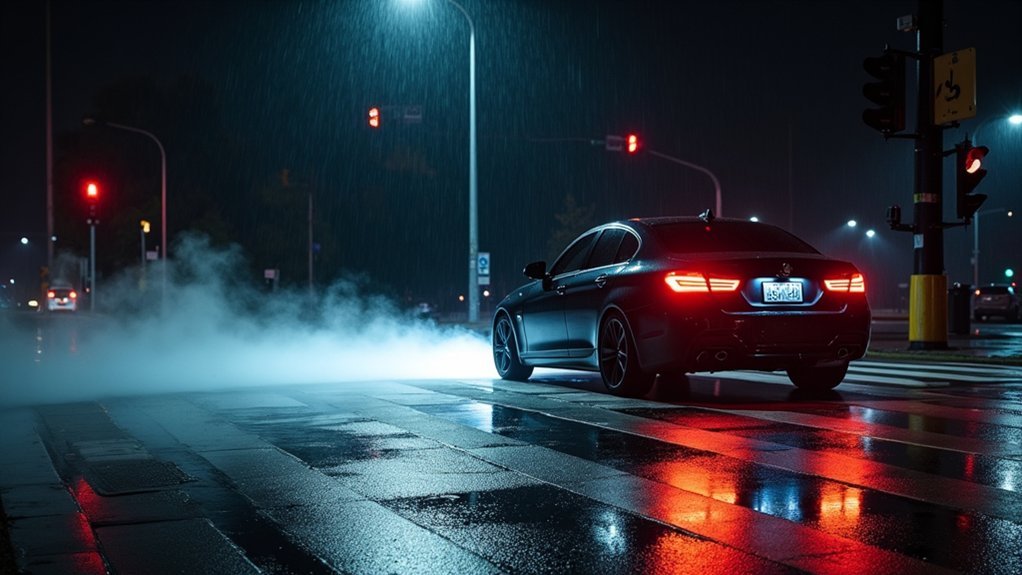
Red light cameras combine flash photography with video recording to capture thorough evidence of traffic violations. When motion detection triggers the system as a vehicle crosses the stop bar after the traffic signal turns red, the camera captures two violation images. One is at the stop bar, and the other is in the center of the intersection. Both are illuminated by the flash to improve clarity.
Red light cameras use flash and motion detection to capture clear images of vehicles violating signals.
It also captures a close-up of the vehicle’s license plate, extracted from the violation images.
Plus, there’s a 12-second digital video showing six seconds before and after the violation, providing contextual footage.
This integration of flash images with digital video guarantees that every angle of the violation is documented clearly. The flash improves the visibility of the vehicle and traffic signal status.
Meanwhile, the video confirms the sequence of events at the intersection.
Why Does the Camera Flash Even Without a Violation?
You might notice the camera flash even when no violation actually happens. That’s because the system is designed to capture images whenever a trigger event occurs, not just when there’s an infraction.
For example, the flash could go off if a vehicle stops before the intersection or makes a right turn without coming to a complete stop.
These flashes that happen without a violation are just part of how the automated process works.
But don’t worry—there’s always a review afterwards to make sure citations are only issued for confirmed offenses.
Flash Activation Reasons
Although the camera flash often signals a violation, it can activate without issuing a citation when vehicles stop properly before the intersection or execute right turns without a complete stop.
You may see flash activation for these key reasons:
- Vehicles stop correctly but trigger the sensor, resulting in a photo without a citation.
- Drivers make right turns at red lights without a complete stop; the system captures this but may not issue a ticket.
- Excessive speed approaching the intersection can cause the flash, even if no red-light running occurs.
The review process filters out non-violations, ensuring citations target actual red-light runners.
This system improves traffic safety by documenting potential infractions while maintaining accuracy above 80%.
Non-Violation Flash Occurrences
When the camera flashes without issuing a citation, it’s often because the system detected a situation that warranted recording but didn’t meet the criteria for a violation.
For example, the red-light camera may flash when a vehicle stops before the intersection, signaling activation without a violation.
Likewise, a driver making a right turn on red without a complete stop can trigger a flash, though this doesn’t always lead to a citation.
The camera’s imaging captures scenarios that help review whether a violation occurred.
Over 80% of flashes accurately identify excessive speed approaches, even if no violation is issued.
This flash system serves not only to detect violations but also to deter risky behavior and encourage drivers to stop safely at red lights.
How Does the Flash Help When Reviewing Violations?
The flash from a red light camera plays an essential role in capturing clear and detailed images of a vehicle during a violation. When reviewing violations, flash activation improves the violation assessment by providing:
- Precise images of the vehicle at the stop bar with the red light illuminated, confirming the exact moment of the infraction.
- Clear visibility of the license plate and vehicle details, crucial for correctly identifying the offender during the citation process.
- Enhanced quality of the 12-second digital video recording, supporting thorough documentation and verification of the violation.
These flash-illuminated images and video guarantee that all evidence is accurate and reliable. This helps facilitate objective and efficient processing of red-light camera violations.
This clarity is fundamental for upholding enforcement standards and legal requirements.
Accuracy of Flash Images in Detecting Red-Light Violations
Since accurate identification is vital for fair enforcement, red-light camera systems use flash images to detect violations with over 80% accuracy in cases of excessive speed approaches.
The system captures two key images: one showing the vehicle at the white stop bar with the red-light illuminated, and a second depicting the vehicle within the intersection.
These images, improved by the camera flash for clarity, support the Police Department’s review process. Furthermore, a 12-second digital video records six seconds before and after the infraction, bolstering evidence accuracy.
While the flash may trigger during non-violation events, such as incomplete stops on right turns, citations are only issued when clear violations are confirmed.
This rigorous imaging and review protocol guarantees that red-light violation citations rely on precise, verifiable evidence.
Tips to Avoid Triggering Red Light Camera Flashes
Understanding how red-light camera flashes are triggered can help you adjust your driving to avoid unnecessary activation. To prevent a camera flash at an intersection, follow these key tips:
- Always come to a complete stop before the white stop line when the traffic signal turns red.
- When making a right turn on red, stop fully before proceeding to prevent triggering the camera flash.
- Monitor the traffic signal for stale green lights and prepare to stop early, minimizing forward motion past the stop bar after the red light activates.
The red-light camera system detects motion just before the stop bar once the light turns red.
Any forward movement without stopping can trigger a camera flash, so practicing these behaviors guarantees compliance and avoids unnecessary activation.
Frequently Asked Questions
Can Red Light Camera Flashes Damage My Car’s Paint or Sensors?
No, red light camera flashes won’t damage your car’s paint or sensors. They emit brief, high-intensity white light designed solely for clear photo capture, staying well within safe limits.
Your vehicle’s finish and electronic systems, including parking and collision sensors, aren’t affected by this flash.
Manufacturers and studies haven’t documented any harm from these flashes, so you can trust that your car remains protected during red light camera activations.
Are Red Light Camera Flashes Harmful to Pedestrians or Cyclists?
No, red light camera flashes aren’t harmful to you as a pedestrian or cyclist. They emit brief, controlled light bursts comparable to standard traffic signals, guaranteeing no lasting effects or dangerous distractions.
The flashes focus on vehicles and license plates, not people. You can rely on these systems to promote safer intersections without risking your vision or safety.
Proper signage further guarantees you remain aware of their presence.
Do Red Light Camera Flashes Affect Night Vision for Drivers?
Yes, red light camera flashes can affect your night vision temporarily.
The bright white burst emitted at activation can cause a momentary glare, impairing your ability to see clearly in low-light conditions.
This sudden exposure to intense light may delay your eyes’ adjustment back to darkness, potentially distracting you or causing unsafe reactions when approaching an intersection at night.
It’s important to stay alert and avoid sudden maneuvers after a flash.
Can the Flash Cause Temporary Blindness or Distraction While Driving?
The flash can be a double-edged sword, causing temporary blindness or distraction while you’re driving.
Its bright burst, similar to a camera flash, can momentarily impair your night vision or divert your attention from the road.
This sudden glare, especially in low-light conditions, can reduce your ability to focus, increasing the risk of accidents.
While it captures violations, it can also briefly interrupt your visual processing and driving performance.
Are Drivers Notified When a Red Light Camera Flashes at Their Vehicle?
No, you won’t be immediately notified when a red light camera flashes at your vehicle. The flash is part of the automated capture process used to document potential violations.
After the event, law enforcement reviews the images and video before deciding whether to issue a citation.
If they confirm a violation, you’ll receive a Notice of Violation by mail.
This guarantees accuracy and fairness before any penalties are applied.
Conclusion
You might think a red light camera flash only fires when you blatantly run a red light, but ironically, it often flashes even when you don’t. This isn’t a malfunction. It’s designed to capture clear, precise evidence under varying conditions.
So next time you’re startled by that sudden flash, remember it’s a calculated part of an accurate, automated system ensuring traffic law enforcement is both fair and reliable.